
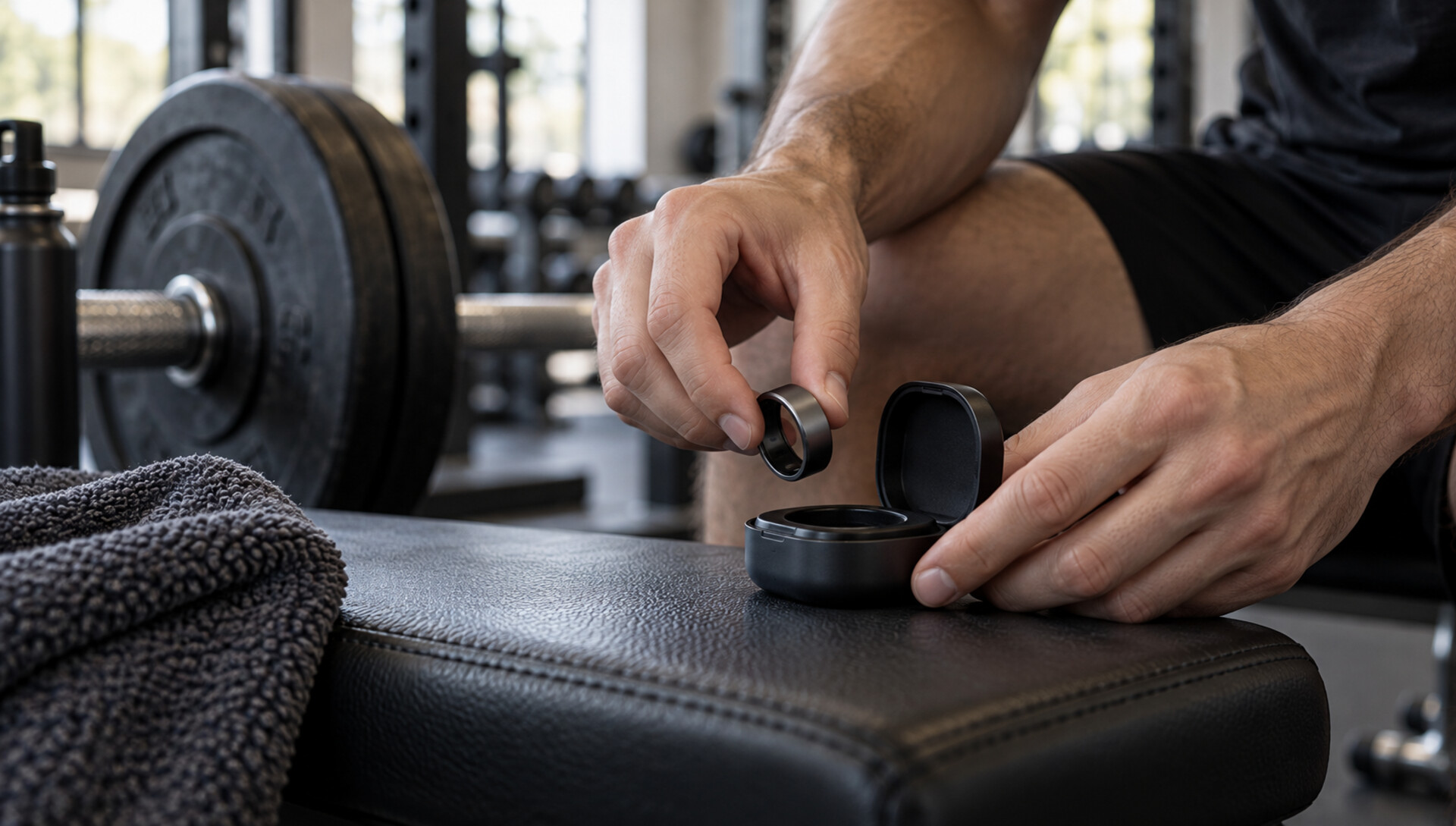
Featured image: AI-generated editorial illustration.
Check your smart ring’s instructions before lifting weights, and remove it for activities the maker advises against. A ring that feels comfortable at a desk may press against your finger when you grip a barbell. Oura specifically recommends removing its ring during activities that create excessive friction, including weightlifting.
You can still use a smart ring as part of a training routine without wearing it through every set. The practical questions are whether the ring is appropriate for the exercise, what information you want to record, and how to keep it secure when it is off your hand.
Why does lifting feel different from everyday wear?
Your hand changes shape as you close it around a handle. The ring can become a contact point between your finger and the equipment, and textured metal can rub against its finish. A loose fit is not a sensible solution: it changes the way the device sits and may still leave it uncomfortable when gripping.
Think about the actual exercise. Sitting on an exercise bike without loading the hands is different from holding a heavy dumbbell, hanging from a bar or using a cable handle. Do not assume a general “fitness tracker” description makes every one of those uses suitable.
Our guide to heart-rate zones explains a separate training question. Deciding how hard to exercise and deciding whether a ring belongs under a loaded grip are different decisions.
What does the manufacturer actually recommend?
Use the support page for your exact brand and generation. Oura’s general FAQs recommend removing the ring during excessive-friction activities such as weightlifting. That is a specific instruction, not simply an optional accessory recommendation.
For another brand, read its current safety, activity, fit and warranty information rather than applying Oura’s wording automatically. Keep a screenshot or saved copy of the relevant instructions if you are buying primarily for gym use.
| Question | Why it matters | What to do |
|---|---|---|
| Does the maker advise removing it? | Daily-wear marketing does not override activity restrictions | Follow the model's instructions |
| Does it press against the bar or your finger? | Your loaded grip differs from an open hand | Remove it rather than changing your grip around it |
| Is it rubbing against equipment? | A coating can still show wear | Check the maker's friction guidance |
| How will the workout be recorded? | Tracking options differ by app and model | Use a supported logging or integration method |
| Where will the ring go? | A small ring is easy to leave on a bench | Use a dedicated secure case |
Our smart-ring comparison helps with broader buying decisions. Before choosing one for strength training, give its activity guidance the same attention as battery life or subscription cost.
Do gloves or ring protectors solve the problem?
Do not assume so. A cover may be marketed for surface protection, but that does not establish that the ring is suitable under a loaded grip. Gloves also do not cancel an instruction to remove the ring.
If you already find the ring uncomfortable, adding layers is not a reason to keep lifting through it. Check the ring maker’s advice and the accessory’s compatibility information. Avoid treating a seller’s photograph of someone holding a dumbbell as a substitute for those instructions.
How useful is a ring for live workout information?
Ask what you actually need. Some people want an easy way to record that a session happened. Others need live heart-rate feedback, an interval timer, set logging or a clearly visible display. Those are different requirements, and a small ring does not automatically meet all of them.
Research on wrist-worn optical sensors demonstrates that measurement error depends on the device and conditions. It is not direct validation of a particular smart ring or current strength-training feature (Bent et al., 2020).
Your training plan should not depend on one wearable score alone. Our deload-week guide looks at planned reductions in training load, a separate decision from whether an individual workout was recorded perfectly.
Can you record a workout after removing the ring?
Check the app’s supported options. Oura documents manual activity entry and integrations with other services. Features can change, so use the current help instructions rather than an old screenshot of the app.
- Decide before training whether the ring needs to come off.
- Put it in the same secure case or compartment each time.
- Record the session using a permitted method or another suitable device.
- Check for duplicate entries if two services synchronise the workout.
- Clean and replace the ring as directed when the session is over.
Do not deliberately keep the ring on during a prohibited activity just to avoid an empty period in the app. A complete-looking chart is not a reason to ignore product guidance.
What should strength trainees compare before buying?
Start with comfortable fit, activity restrictions and the information the app actually provides. Then compare ongoing fees, supported phones, return conditions and how workouts are entered when the ring is not worn.
Our RingConn review provides another product format to compare. Review the current model’s instructions directly; a brand-level review does not establish that every generation has identical activity rules.
Frequently asked questions
Can I wear an Oura Ring while lifting weights?
Oura recommends removing its ring during activities that create excessive friction, including weightlifting. Follow its current instructions for your model.
Will a ring protector prevent all damage?
Do not assume that. A surface cover is not proof that a ring is suitable under a loaded grip or overrides the manufacturer's restrictions.
Should I buy a larger ring for the gym?
Do not choose an unsuitable daily fit to accommodate lifting. Use the correct sizing process and remove the ring when activity guidance requires it.
Will taking the ring off lose the entire workout?
That depends on the app. Some support manual entries or integrations. Check the current options and avoid duplicate entries when services synchronise.
Is a ring the best device for live training feedback?
Choose around the task. If you need a visible display or particular live measurements, compare devices providing those features and check their validation for the activity.
References
- Bent, B., Goldstein, B. A., Kibbe, W. A., & Dunn, J. P. (2020). Investigating sources of inaccuracy in wearable optical heart rate sensors. npj Digital Medicine, 3, Article 18. https://doi.org/10.1038/s41746-020-0226-6
- Oura. (n.d.). General FAQs. Retrieved November 2, 2026, from https://support.ouraring.com/hc/en-us/articles/4408961184147-General-FAQs
- Oura. (n.d.). Record a workout with Oura. Retrieved November 2, 2026, from https://support.ouraring.com/hc/en-us/articles/42821224955795-Record-a-Workout-with-Oura


