
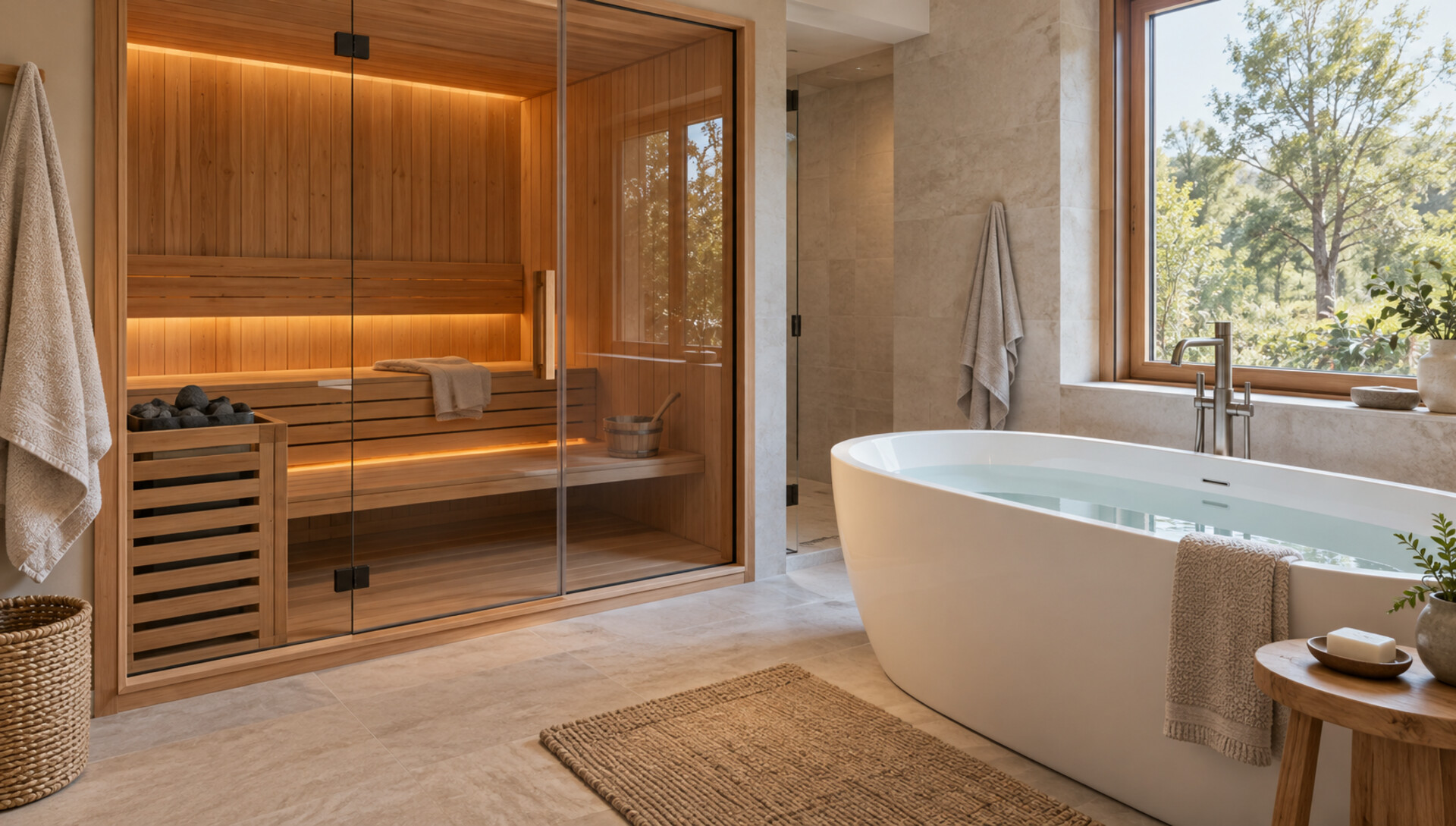
Featured image: AI-generated editorial illustration.
A sauna and a hot bath can both be ways to spend time in heat, but they are different exposures. Choose around comfort, access and what you want from the session. Neither a higher temperature nor a bigger sweat proves that one is better for recovery.
The research question also needs to be specific. A study measuring body temperature or blood flow during one session does not establish that the same option improves next-day performance, treats pain or produces the best long-term health outcome. A useful comparison keeps those outcomes separate.
This article is general information. Ask your clinician about suitability if you have a relevant health condition, take medication affecting heat tolerance, or have been advised to limit heat exposure.
How is a sauna different from a hot bath?
In a bath, part of your body is immersed in water. In a sauna, you sit in a heated environment without that immersion. The medium, exposed surface area, humidity, posture and duration differ, so thermostat numbers are not directly interchangeable.
There is another distinction within the sauna category. Our guide to traditional, infrared and steam saunas explains the different formats. An article comparing a traditional sauna with a bath should not quietly apply its conclusions to every infrared cabin or sauna blanket.
| Consideration | Sauna | Hot bath |
|---|---|---|
| Setup | Suitable cabin or access to a facility | A suitable existing bathtub, if available |
| Exposure | Heated surroundings; type and humidity vary | Water immersion; depth and temperature vary |
| Preparation | Warm-up and operating checks | Filling, temperature checking and safe access |
| Ongoing care | Cleaning, drying and heater maintenance | Tub cleaning, water use and bathroom care |
| Cost comparison | Equipment or facility fees plus operating costs | Water heating, water use and existing installation costs |
| Personal preference | May suit someone who prefers sitting outside water | May suit someone who enjoys supported immersion |
Has research directly compared the two?
Yes. Atencio and colleagues compared acute hot-water immersion, traditional sauna and far-infrared sauna in 20 healthy young adults. The tested conditions produced different thermoregulatory, cardiovascular and immune responses. Hot-water immersion produced the largest responses for several measured variables under those specific protocols (Atencio et al., 2025).
That is useful evidence, but the study was not a contest to identify the safest or best home routine for everyone. The conditions were controlled, the sample was small, and the outcomes concerned a single exposure. Do not copy the research temperatures and durations as a personal prescription.
It also does not justify promising that one bath will produce better muscle recovery than one sauna session. The study question and the reader’s goal need to match before making that claim.
Which is more useful after exercise?
First decide what “useful” means. A quiet routine you enjoy, less perceived stiffness, a training adaptation and improved next-session performance are separate outcomes. If your main aim is relaxation, convenience and comfort may be the deciding factors.
If you want a measurable athletic outcome, look for studies measuring that outcome in a relevant population and setting. Our overview of sauna and recovery provides wider context, but no heat session should be presented as a substitute for sleep, food and sensible training.
Finish your normal exercise cooldown and consider how you feel before adding heat. Avoid treating a hard workout as a reason to tolerate an uncomfortable bath or sauna. If you feel unwell, additional heat is not a recovery requirement.
Does sweating more make one option better?
No useful personal ranking can be made from visible sweat alone. Sweat has an important thermoregulatory role, but the amount you see does not establish a particular clinical benefit or a “detox” result (Baker, 2019).
A bath makes visual comparisons particularly unreliable because your skin is already in contact with water. Keep the setting appropriate, follow relevant operating instructions and leave if you feel unwell. Do not keep increasing exposure to make the two experiences look or feel identical.
How should you compare cost and convenience?
Use your actual situation. If a suitable bathtub already exists, its incremental cost is different from installing a new sauna. If you already use a sauna at a gym, a home installation price is not the relevant comparison either.
For a home sauna, account for equipment, installation needs, your electricity tariff and maintenance. For a bath, account for water volume, hot-water-system efficiency and local tariffs. Avoid one universal “cost per session” without stating those assumptions.
Our home infrared sauna comparison helps with cabin decisions. If storage and installation space are your main constraints, our sauna-blanket guide covers another format. A blanket still has its own instructions and is not interchangeable with a bath or cabin.
What heat precautions matter for either option?
Make it easy to leave safely, avoid entering a bath or operating equipment while impaired, and follow any individual clinical advice. A home setting does not remove the need to pay attention to symptoms.
If heat makes you dizzy, weak, nauseated or otherwise unwell, stop the exposure and cool down. Confusion, a seizure, loss of consciousness or other severe heat-related symptoms require emergency help. In Australia, call 000 for a medical emergency (NHS, 2026).
The practical choice is the one that fits your circumstances and can be used appropriately. You do not need to prove that your preferred option creates the strongest physiological response to justify enjoying it.
Frequently asked questions
Is a hot bath the same as an infrared sauna?
No. Water immersion and an infrared cabin expose you to heat differently. Temperature, depth, humidity and duration affect the comparison, so settings are not interchangeable.
Is a bath better for muscle recovery?
That requires evidence for the specific recovery outcome and protocol. A larger short-term temperature or cardiovascular response does not by itself prove better next-day recovery.
Should I match the temperatures?
No. A temperature number means something different in water and air. Do not use a sauna temperature as a target for bathwater or copy a study protocol into a home routine.
Which costs less to use?
It depends on existing equipment, water volume, heating efficiency, tariffs and facility fees. Compare your own assumptions rather than a universal price.
Should I use both in one evening?
There is no general need to combine them. More heat is not automatically better. Follow personal medical advice and stop if you feel unwell.
References
- Atencio, J. K., Reed, E. L., Wiedenfeld Needham, K., Lucernoni, K. M., Comrada, L. N., Halliwill, J. R., & Minson, C. T. (2025). Comparison of thermoregulatory, cardiovascular, and immune responses to different passive heat therapy modalities. American Journal of Physiology-Regulatory, Integrative and Comparative Physiology, 329(1), R20–R35. https://doi.org/10.1152/ajpregu.00012.2025
- Baker, L. B. (2019). Physiology of sweat gland function: The roles of sweating and sweat composition in human health. Temperature, 6(3), 211–259. https://doi.org/10.1080/23328940.2019.1632145
- NHS. (2026, May 28). Heat exhaustion and heatstroke. https://www.nhs.uk/conditions/heat-exhaustion-heatstroke/


