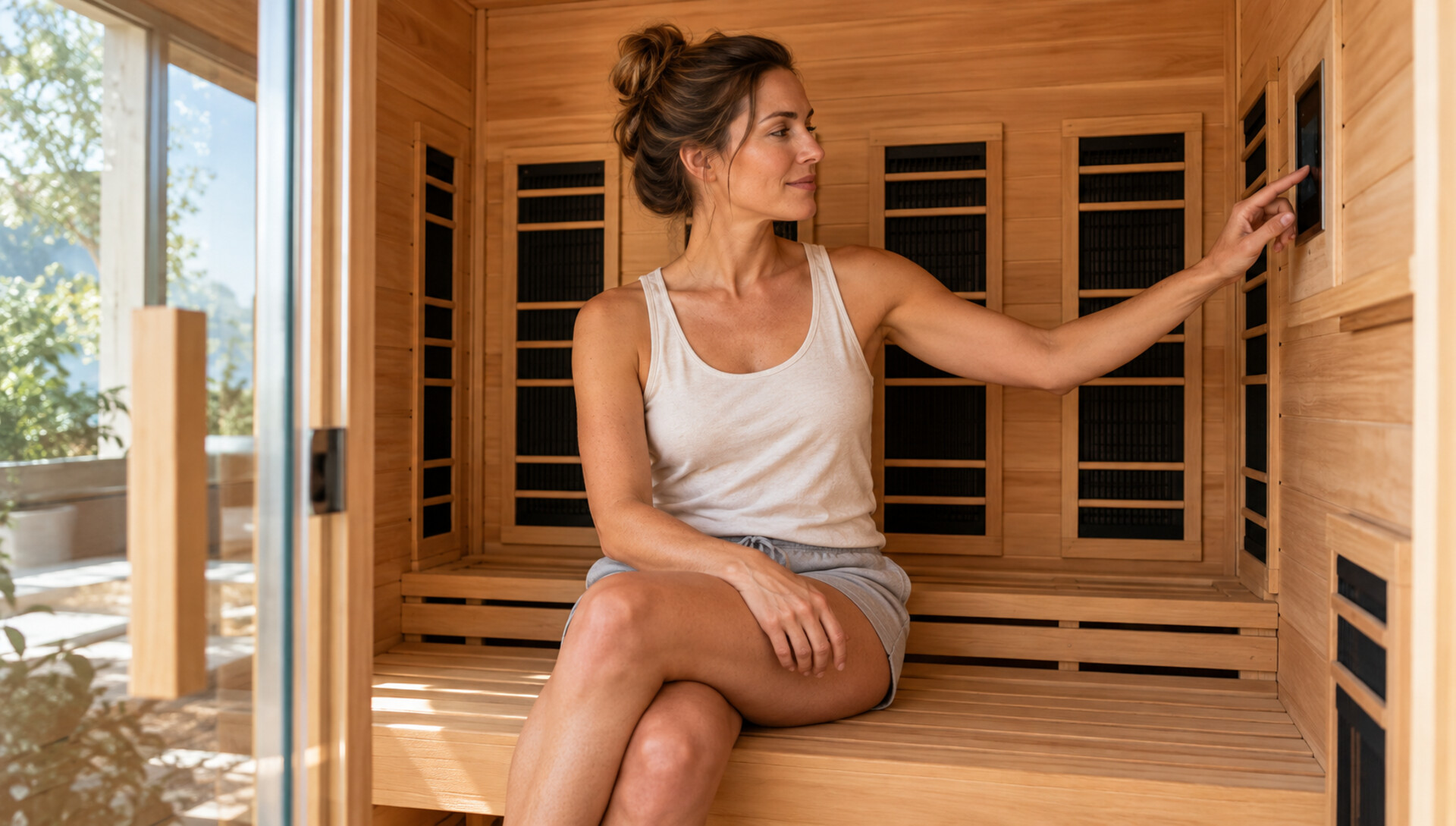
Featured image: AI-generated editorial illustration.
If you are not sweating much in an infrared sauna, check the setup without trying to force a bigger sweat. Warm-up, settings, the room and individual responses can affect what you notice. One session cannot tell you whether the equipment is faulty, whether you have received a health benefit, or why you are sweating less.
If you feel overheated, dizzy, weak or otherwise unwell, leave the heat and cool down. Little visible sweat is not a reason to turn the temperature up or extend the timer. If you also sweat unusually little during ordinary activity or warm weather, seek medical advice rather than treating it only as a setting problem.
This is general information. Seek individual advice about heat exposure if you have a relevant medical condition or medication concern. Call 000 in Australia for a medical emergency.
Why might you sweat less in an infrared sauna?
Separate two questions: is the sauna operating as intended, and is your sweating response different from usual? Treating them as one issue can mean missing a faulty setup or dismissing a broader health concern.
Sweat production varies with thermal conditions and individual factors. Sweating helps regulate body temperature, but visible moisture is not a complete measure of the heat stress you are experiencing (Baker, 2019).
Infrared equipment also differs from a traditional stone-heater sauna. Our guide to how infrared saunas work explains the basic format. Matching a traditional sauna’s air temperature is not automatically the correct goal for an infrared cabin.
Which equipment checks come first?
Use the instructions for your model. Check that the stated warm-up has finished, the selected setting is appropriate and the controls show no error. Note whether the door closes correctly and the room meets the installation requirements.
Do not touch heating panels to test them, cover them with fabric or add water to infrared equipment. If heating seems uneven, something is damaged or an error returns, switch off and contact the supplier. An owner’s inspection is different from an electrical repair.
| Observation | What to check | Next step |
|---|---|---|
| Cabin has barely warmed | Warm-up instructions, settings and room conditions | Compare the setup with the manual before another session |
| Error or suspected failed heater | Displayed code and visible damage without touching hot parts | Stop use and contact the supplier |
| Little sweat without another change | Whether it is one observation or a recurring pattern | Do not chase sweat with extra heat or time |
| Less sweating during activity too | When it started and any other symptoms | Arrange medical assessment |
| Feeling hot, dizzy or unwell | Symptoms take priority over the timer | Leave the heat, cool down and seek help if symptoms persist or are severe |
When comparing equipment, our home infrared sauna guide covers different formats. Clear operating documentation and useful support matter more than a promise about how quickly every buyer will sweat.
Should you increase the heat or stay longer?
Not simply to make perspiration visible. Treat the timer as a limit to manage, not an obligation to complete regardless of how you feel. Keep within the manufacturer’s instructions and any individual clinical advice.
Our sauna temperature and duration guide provides wider context. Do not combine the hottest setting from one source with the longest time from another. That ignores differences in equipment and personal circumstances.
Avoid piling on clothing, wrapping yourself in extra layers or blocking ventilation to force sweating. If the unit cannot operate normally under its stated conditions, speak to the supplier rather than working around the problem while inside.
Does less sweat mean less benefit?
You cannot determine that from sweat alone. Feeling relaxed, seeing perspiration and demonstrating a clinical outcome are different observations. A dry towel does not establish that nothing happened, and a soaked towel does not establish a medical benefit.
Sweat physiology research describes temperature regulation as its central role. The amount visible on your skin is not a validated personal toxin-removal score (Baker, 2019). Sweat-chasing is therefore a poor basis for increasing exposure.
A useful record is simple: model, setting, time, room conditions and how you felt. Share it with a supplier or clinician if a problem recurs. It is not a home measurement of core temperature or a diagnostic test.
When should reduced sweating be checked medically?
Cleveland Clinic advises assessment when you notice little or no sweating in situations that normally make you perspire. There can be several causes, including medication effects. The sauna observation alone cannot identify one, and you should not stop a prescription to test the idea (Cleveland Clinic, 2021).
Leave a heated environment if you feel unwell. Confusion, a seizure, loss of consciousness or other severe heat-related symptoms require emergency help. Heatstroke is a medical emergency; do not wait for sweating to appear before acting (NHS, 2026).
For a model-specific ownership example, our Inner Light Mali review compares cabin formats. Those differences can inform a purchase but cannot explain an individual’s reduced sweating.
Frequently asked questions
Does an infrared sauna have to make me sweat heavily?
No fixed amount of visible sweat establishes a successful session for every person. Follow the instructions and pay attention to symptoms rather than using perspiration as a target.
Could the room affect warm-up?
Check the model's permitted installation environment. Record conditions if it struggles to warm up and ask the supplier instead of changing the electrical setup yourself.
Should I drink a large amount to force sweating?
No. Follow ordinary hydration needs and any medical fluid advice. Do not rapidly drink large amounts to make a sauna session produce sweat.
Can medication affect sweating?
Some medicines can, but a clinician should assess that possibility. Keep a medication list and do not stop or change a prescription to experiment with heat.
When is it more than equipment troubleshooting?
Arrange medical advice if reduced sweating also occurs in warm weather or activity, or clearly changes from your usual pattern. Severe heat-related symptoms require urgent help.
References
- Baker, L. B. (2019). Physiology of sweat gland function: The roles of sweating and sweat composition in human health. Temperature, 6(3), 211–259. https://doi.org/10.1080/23328940.2019.1632145
- Cleveland Clinic. (2021, April 19). Anhidrosis (lack of sweat). https://my.clevelandclinic.org/health/diseases/15891-anhidrosis-lack-of-sweat
- NHS. (2026, May 28). Heat exhaustion and heatstroke. https://www.nhs.uk/conditions/heat-exhaustion-heatstroke/