Our buyer's guides are based on years of collective experience from our health enthusiasts, fitness experts, and real-world input from our community. They reflect informed perspectives—not sponsored endorsements.
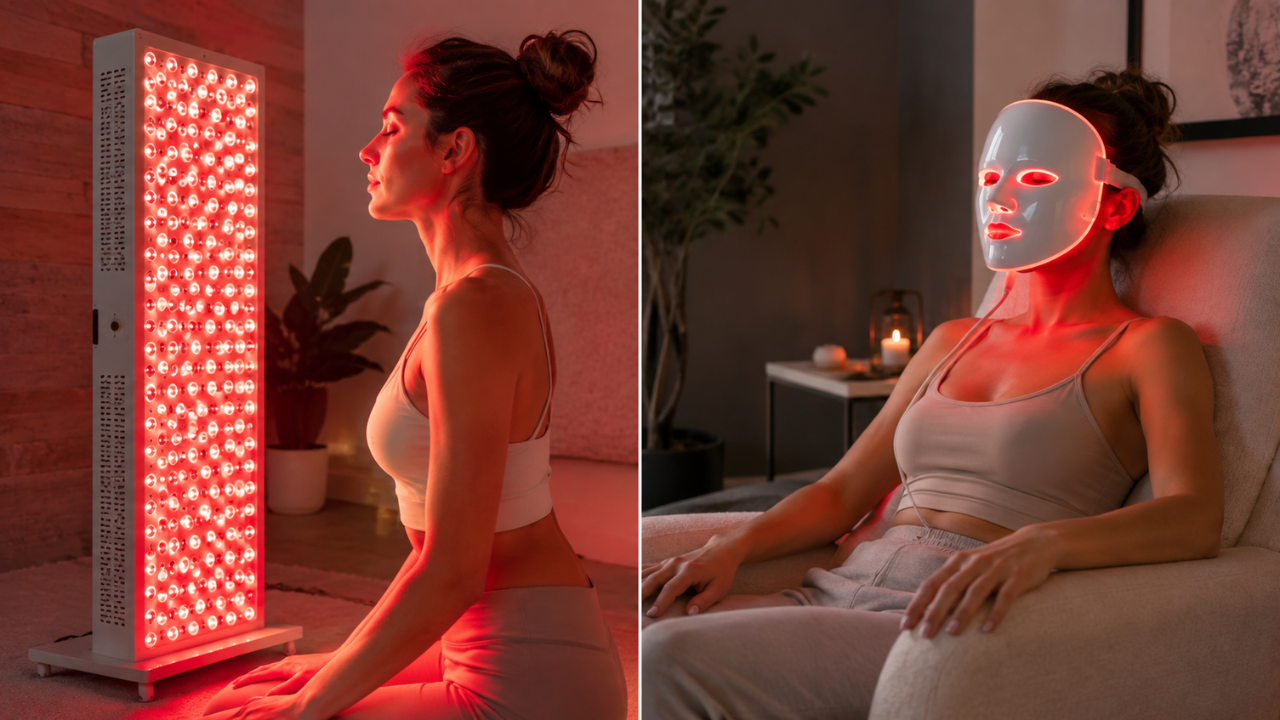
A red light therapy panel is better for treating larger areas and using one device for skin, muscles and general recovery. A mask is better when your main goal is facial skincare and you want a compact, hands-free option.
Neither format is automatically more effective. Results depend on wavelength, irradiance, treatment time, fit, distance and how consistently you use the device. The best choice is the one that delivers an appropriate dose to the area you actually want to treat.
Is a Red Light Therapy Panel Better Than a Mask?
A panel is more versatile. You can position it in front of your face, torso, back, arms or legs, and larger models can cover several areas at once. This makes a panel a practical option for households with different goals.
A mask is more specialised. It sits on or close to the face and holds the light at a fixed position. You can often move around during a session, and storage is easier than with a freestanding panel.
If facial skincare is your only priority, a mask may be all you need. If you also want to target shoulders, knees, back or large muscle groups, compare the best red light therapy panels in Australia before committing to a face-only device.
What Is the Difference Between a Panel and a Mask?
The biggest differences are coverage, position and flexibility.
A panel uses an array of LEDs on a flat surface. You normally sit or stand at the distance recommended by the manufacturer. Moving farther away increases the area covered but usually reduces irradiance at the skin.
A mask curves around the face. Some models touch the skin while others sit slightly away from it. The fixed geometry makes each session easy to repeat, although fit can vary between users.
In practical terms:
- Panel: Larger treatment area, adjustable distance, more body uses and more space required.
- Mask: Face-focused coverage, fixed position, portable design and limited use elsewhere.
Is a Red Light Therapy Mask Stronger Than a Panel?
Not necessarily. A mask can sit close to the skin, but closeness alone does not tell you the dose. LED output, beam angle, treatment time and the way light is distributed across the face all matter.
A powerful panel can deliver high irradiance, but advertised figures may be measured directly at the device rather than at a realistic treatment distance. A mask may use lower irradiance over a longer preset session. Either approach can deliver a meaningful energy dose when the device is well designed.
Avoid choosing by the largest power number on a product page. Look for wavelength, irradiance at a stated distance, recommended session time and information about how the output was measured.
Which Is Better for Facial Skin?
A mask is usually the more convenient option for facial skin. It keeps the LEDs aligned with the cheeks, forehead and jaw, and a preset timer removes much of the guesswork.
A panel can still work well for the face. It may offer stronger output, a choice of red and near-infrared settings and enough coverage for the neck and upper chest at the same time. The trade-off is that you need to maintain the recommended distance and position.
Clinical research on red and near-infrared light has reported improvements in measures such as skin roughness, fine lines and collagen density under specific protocols. Those results cannot be applied to every home device. If facial care is your priority, our guide to the best red light therapy masks explains the features worth comparing.
Which Is Better for Muscle Recovery and Pain?
A panel is the clear choice for muscles and joints. A medium or large unit can cover the quadriceps, hamstrings, back or shoulders without requiring a separate wearable for each area.
Near-infrared wavelengths are commonly included in panels because they are used when the target is below the skin’s surface. The ideal parameters still depend on the tissue, condition and device. Photobiomodulation follows a dose-response relationship, so adding more time is not always better.
A mask is not designed for sports recovery. Even if it includes near-infrared LEDs, its shape and controls are intended for the face.
Which Device Is Easier to Use Consistently?
A mask is often easier for a single facial session. Put it on, start the timer and follow the prescribed schedule. Rechargeable models can be used away from a wall outlet.
Think about where the device will live before buying it. If a panel must be unpacked and moved every time, a smaller product you can reach easily may receive more use.
What Should You Check Before Buying Either Device?
Compare the specifications that affect the light reaching your skin:
- wavelengths and whether red and near-infrared can be controlled separately
- irradiance measured at a stated, realistic distance
- recommended treatment time and frequency
- coverage area at that distance
- timer and brightness controls
- mask fit, panel mounting and overall comfort
- warranty, electrical certification and local support
- cleaning instructions for anything that touches the skin
The wider benefits of red light therapy depend on the application and protocol. A long feature list cannot compensate for a device that is uncomfortable or poorly matched to your goal.
Do You Need Eye Protection With a Panel or Mask?
Follow the manufacturer’s eye-safety instructions for the exact product. A panel can be very bright, particularly at close range, and staring directly at the LEDs is unnecessary.
Some masks include eye inserts or are designed to limit direct glare. Fit matters, and near-infrared light is invisible even though the LEDs may still be active. If a session causes eye discomfort, headache or after-images, stop and review the setup.
Our guide to eye protection for red light therapy covers panels, masks and common protective options.
Can You Use a Panel and a Mask on the Same Day?
You can, but doubling up on the same facial area is usually unnecessary. More exposure does not guarantee a better response, and the total dose becomes harder to track.
If you own both, give them separate roles. Use the mask for facial sessions and the panel for larger body areas. Follow each device’s protocol and avoid stacking treatments unless a qualified clinician has set a specific plan.
Who Should Choose a Panel?
Choose a panel if you want to treat multiple body areas, share the device, cover large muscles or adjust the distance and settings. It is also the better long-term option when your goals extend beyond facial skincare.
Choose a mask if you mainly care about the face, have limited storage space or value a simple hands-free routine.
Conclusion
A red light therapy panel offers greater coverage and flexibility. A mask offers convenience and repeatable facial positioning.
Choose by treatment area first, then compare wavelength, measured output, session time and comfort. The best device is not the brightest or most expensive one. It is the device that gives the intended area a controlled, consistent dose.
References
Girasol, C. E., Braz, G. de A., Bachmann, L., Celli, J., & Guirro, R. R. de J. (2022). Laser light sources for photobiomodulation: The role of power and beam characterization in treatment accuracy and reliability. PLOS ONE, 17, e0266193. https://doi.org/10.1371/journal.pone.0266193
Wunsch, A., & Matuschka, K. (2014). A controlled trial to determine the efficacy of red and near-infrared light treatment in patient satisfaction, reduction of fine lines, wrinkles, skin roughness, and intradermal collagen density increase. Photomedicine and Laser Surgery, 32, 93–100. https://doi.org/10.1089/pho.2013.3616
Zein, R., Selting, W., & Hamblin, M. R. (2018). Review of light parameters and photobiomodulation efficacy: Dive into complexity. Journal of Biomedical Optics, 23, 120901. https://doi.org/10.1117/1.JBO.23.12.120901