You can consider a massage gun before or after exercise, provided its use suits your health, the activity and the device instructions. Before training, think about whether it helps you feel ready to move. Afterwards, think about comfort. Neither timing is a guarantee of better performance or faster muscle repair.
A useful routine starts with a reason for using the device. A few comfortable passes over an appropriate muscle area are different from a long, intense session immediately before a demanding lift or sprint. More time and force do not automatically make either approach more useful.
Quick takeaways
- Before exercise, a massage gun can be an optional addition to your preparation.
- Keep your normal movement-based warm-up and activity-specific practice.
- After exercise, judge comfort separately from claims about next-day performance.
- Use the exact model’s guidance for attachments, areas, intensity and duration.
What are you trying to achieve before training?
Be specific. You may want to assess how an accessible muscle feels before moving through your warm-up. That is a different goal from expecting the device to prevent injury or improve your personal best.
A systematic review found possible short-term flexibility benefits, while effects on strength and explosive activities were inconsistent. Most included studies also had a moderate risk of bias. Those findings do not support a universal pre-workout prescription (Ferreira et al., 2023).
Use the device as an optional step, then assess the movement you are preparing to perform. If you still feel restricted, sore or unable to move normally, reconsider the session rather than increasing the percussion until you can ignore the problem.
Our massage-gun buyer’s guide explains the features behind the sensation. Changing attachments or speed changes the setup, so copy the instructions for your own model rather than another person’s routine.
Where does it fit in a warm-up?
Keep the warm-up focused on the activity ahead. That may include easy movement, controlled range-of-motion work and gradually heavier or faster practice for the exercise you will perform.
If you choose to add a gun, make the step brief enough that it does not crowd out that preparation. Then move again and decide whether the area feels comfortable and ready for the intended task.
For example, someone preparing for a lower-body gym session might first walk or cycle gently, use their device as directed on a suitable muscle area, and then complete their normal practice sets. This is an illustration of sequencing, not a tested treatment protocol.
You should be able to leave the device out when it is inconvenient. A routine that only feels possible after an increasingly intense percussion session needs reassessment.
What about using it after a workout?
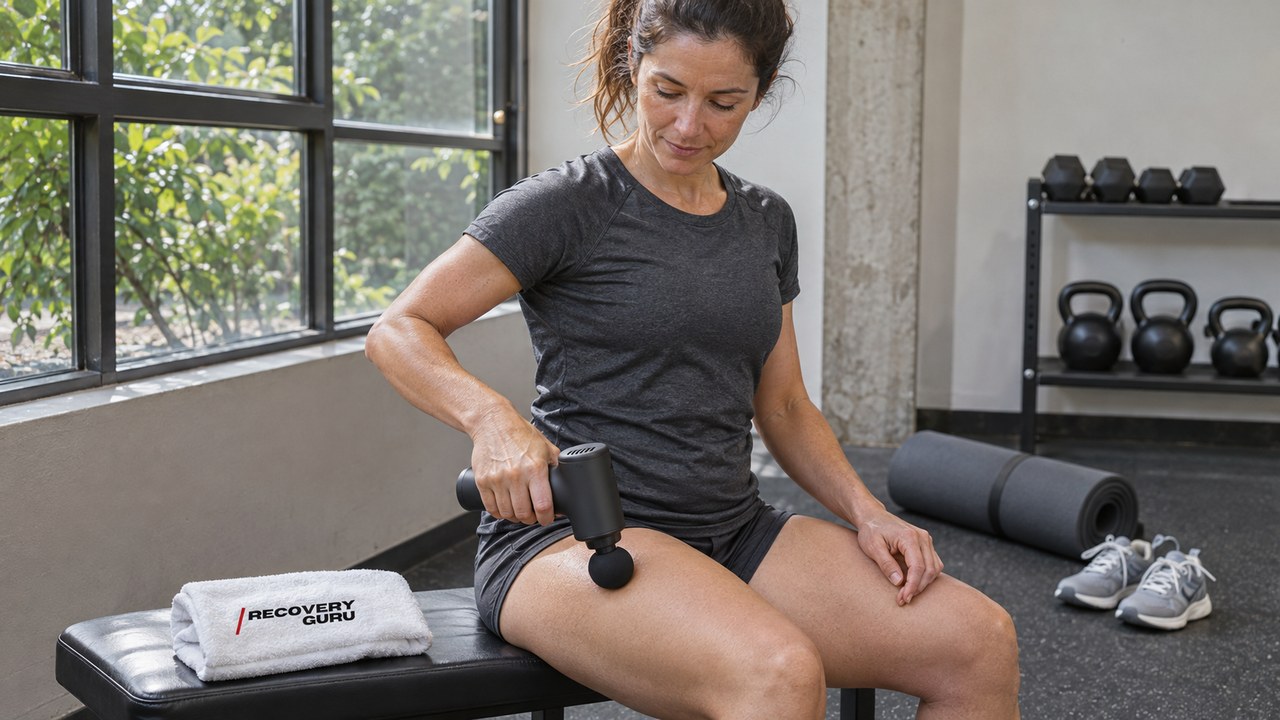
An after-training session may appeal because you have more time and can judge comfort without immediately returning to a heavy set. Settle into a position where you can handle the device without straining to reach.
Allow your breathing and effort to settle as appropriate to the workout. Then follow the manufacturer’s instructions for suitable muscle areas, contact, speed and time. Keep food, fluids and your next night’s sleep in the wider plan.
A review of percussive therapy found promising findings alongside important limitations in study quality and reporting. Feeling less uncomfortable after a session does not establish that damaged tissue has repaired or that tomorrow’s performance will improve (Sams et al., 2023).
When comparing massage guns available in Australia, pay attention to handling and usable controls. You need to be able to stop or adjust the session easily.
| Timing | A useful question | What still matters |
|---|---|---|
| Before exercise | Does this optional step leave the area comfortable for my warm-up? | Normal preparation and practice for the activity |
| After exercise | Is the session comfortable and easy to control? | Food, fluids, sleep and the next training load |
| On a day without training | Does the device serve a clear purpose today? | The instructions and how the area feels |
| When something hurts unusually | Should this area be assessed first? | Symptoms and appropriate clinical advice |
Is there one correct number of minutes?
There is no single time that applies to every device, muscle, person and goal. Published studies use specific protocols; a study’s treatment time is not automatically your home-use instruction.
Read the manual or official routine for the exact model. Take account of the attachment, intensity, intended area and any automatic shut-off. A shut-off feature is a device control, rather than evidence that every person should use the full available time.
If you regularly travel or want a shorter setup, our mini massage-gun guide compares compact options. A smaller device still needs its own appropriate-use instructions.
When should you skip the session?
Skip use over a rash, bruising, an open wound or a new injury until you have suitable guidance. Therabody’s precautions also identify situations such as altered sensation, certain medical conditions and medicines that affect bleeding or sensation. Check the complete list for your product.
Keep percussion away from the head, throat and neck and from direct contact with bones or joints. An attachment’s shape does not make every body area suitable.
If itching develops, stop and check the area. Our article on itching during massage-gun use explains why irritation is not a sign that the session is working better.
How can you decide whether timing helps you?
Keep the comparison simple. Note the activity, device, setting, area and how you felt before and after. Avoid changing the entire workout at the same time and attributing the result to a new timing rule.
You do not need to use the gun both before and after every session. Choose an appropriate routine that is comfortable, repeatable and easy to fit around the essentials of training.
Frequently asked questions
Is before or after always better?
No. The purpose differs, and research does not establish one timing as best for every outcome. Follow the device guidance and keep the activity itself in mind.
Can a massage gun replace my warm-up?
Keep the movement and practice that prepare you for your sport or exercise. A comfortable percussion session does not demonstrate that you are ready for a heavy lift or fast sprint.
Can I use it twice on training days?
Check the manufacturer’s instructions and any clinical advice. Twice-daily use is not a requirement, and repeating a session does not guarantee an additional benefit.
Should I use the strongest setting after a hard workout?
Choose an appropriate, comfortable setting within the instructions. Harder training does not automatically justify more force on the area.
What if the muscle still feels sore afterwards?
Reassess the activity and symptoms. Avoid repeatedly treating the area to make pain easier to ignore, and seek advice for unusual, severe or persistent symptoms.
References
Ferreira, R. M., Silva, R., Vigário, P., Martins, P. N., Casanova, F., Fernandes, R. J., & Sampaio, A. R. (2023). The effects of massage guns on performance and recovery: A systematic review. Journal of Functional Morphology and Kinesiology, 8(3), 138. https://doi.org/10.3390/jfmk8030138
Sams, L., Langdown, B. L., Simons, J., & Vseteckova, J. (2023). The effect of percussive therapy on musculoskeletal performance and experiences of pain: A systematic literature review. International Journal of Sports Physical Therapy, 18(2), 309–327. https://doi.org/10.26603/001c.73795
Therabody. (n.d.). Product warnings and guidance: Precautions and contraindications. https://www.therabody.com/pages/precautions