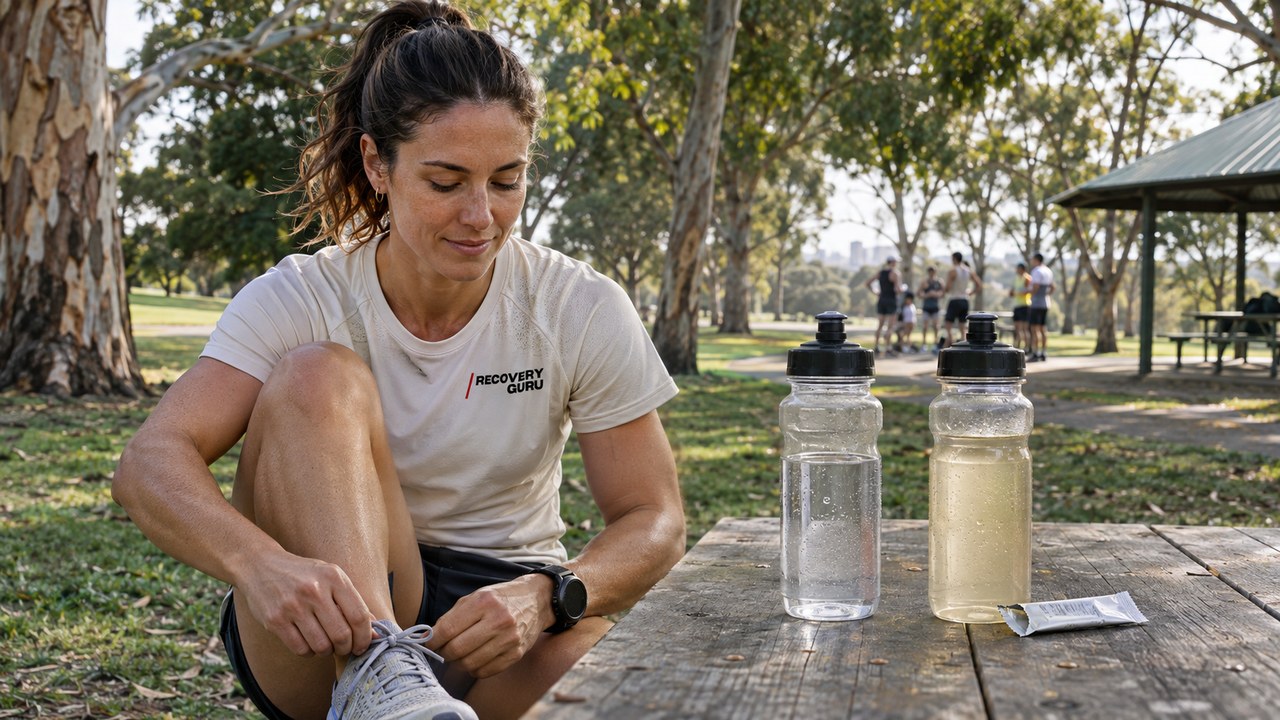
Water is a useful starting point for everyday hydration and many ordinary workouts. An electrolyte drink becomes more relevant when your exercise, sweat losses and eating plan create a need for it. A product containing electrolytes is not automatically a better choice for every session.
The distinction is easier to understand when you look at the whole drink. Some products provide mainly minerals. Others also supply carbohydrate, caffeine or vitamins. Those ingredients do different jobs, and the front label may not make that clear.
Quick takeaways
- Water, food and your usual drinking routine all contribute to hydration.
- Longer or demanding exercise, especially in the heat, can change fluid and fuelling needs.
- Electrolyte tablets, sports drinks and medical oral rehydration solutions are different products.
- Match the drink to the session and follow its mixing instructions. Drinking excessive amounts can be harmful.
What do electrolyte drinks add to water?
Electrolytes include minerals such as sodium and potassium. An electrolyte product adds specified amounts of these to a drink. Food also supplies electrolytes, so the comparison is broader than a bottle of plain water against a supplement sachet.
The Australian Institute of Sport describes sports drinks as products designed to provide carbohydrate and fluid together. Its guidance treats electrolyte-only supplements as a separate category. That difference matters if you want fuel during a session rather than flavour or minerals alone (Australian Sports Commission, n.d.).
For a useful starting comparison, our electrolyte supplement guide introduces several product formats. Check the current label of the particular product you are considering.
When is water a sensible choice?
Water may suit a shorter, comfortable session, particularly when you start normally hydrated, eat regular meals and have ready access to drinks. Think of an easy gym visit or a relaxed walk in mild conditions.
Duration is useful context, but it is not an automatic switch. A short hard session on a hot afternoon can feel very different from a longer easy session indoors. Equally, spending an hour at the gym does not mean you were exercising intensely for an hour.
Harvard’s Nutrition Source notes that dedicated electrolyte drinks are not a healthier everyday choice for the average person simply because they contain added minerals. Consider what your day actually involves before making them a daily habit (Harvard T.H. Chan School of Public Health, n.d.).
When might electrolytes or a sports drink be useful?
More demanding sessions deserve a clearer plan. Consider how long you will exercise, the conditions, how heavily you sweat, access to drinks and whether you will eat during or soon after the session.
The AIS identifies particular uses for electrolyte supplements when fluid and electrolyte losses are substantial. It also stresses the value of an individual plan, ideally with a sports dietitian for demanding training or events. There is no single product or sodium amount that suits every athlete.
Carbohydrate is a separate decision. If a long session requires fuel, a sugar-free electrolyte drink does not provide the same carbohydrate as a standard sports drink. You may need to consider food or another fuelling source alongside your drink.
| Situation | Useful starting point | Question to ask |
|---|---|---|
| Ordinary day with regular meals | Water and your usual food | Is there a specific reason for an added product? |
| Comfortable workout in mild conditions | Water may suit | How demanding was the session, and how much did you sweat? |
| Long or demanding exercise | An individual fluid and fuelling plan | Do you need fluid, sodium, carbohydrate or a combination? |
| Hot conditions with heavy sweating | Review losses and access to drinks | Have you planned for the conditions rather than duration alone? |
| Vomiting, diarrhoea or a medical fluid restriction | Advice from a pharmacist or clinician | Is a medical rehydration product or a personalised plan needed? |
How should you read the label?
Compare products at the concentration you will actually drink. A sachet intended for a litre and a tablet intended for 250 mL cannot be compared fairly by the amount in one packet alone.
Check the prepared volume, sodium per prepared serving, carbohydrate, caffeine and any additional ingredients. Then read the mixing directions. Adding less water to make a drink stronger changes the intended concentration.
Our Sodii hydration salts review is an example of a product-specific assessment. A brand’s range may include different formulations, so use the label for the exact flavour and version you are buying.
Also distinguish a sports product from an oral rehydration solution used for illness. If you are unwell, ask a pharmacist or clinician what is suitable rather than assuming a sports drink is interchangeable with a medical product.
Does a rising heart rate prove you need electrolytes?
A watch reading cannot identify a particular electrolyte deficiency. Heat, effort, duration, hydration and measurement conditions all deserve consideration.
Our guide to cardiac drift during steady exercise explains why a rising reading needs context. Buying a different drink is not a reliable way to diagnose what happened.
If you repeatedly struggle with demanding sessions, record the conditions, duration, food, drinks and symptoms. That record is more useful for a sports dietitian or clinician than the claim that one brand simply did not work.
Can you overdo hydration?
Yes. The National Athletic Trainers’ Association warns that both insufficient and excessive fluid intake can create problems. Adding electrolytes does not give you permission to force down unlimited fluid (McDermott et al., 2017).
Use a plan appropriate to your circumstances. People with kidney or heart conditions, fluid restrictions, or medicines affecting fluid and electrolyte balance should seek personal advice before changing their routine. Severe symptoms during or after exercise require medical assessment, not another bottle of sports drink.
Remember food as well. Our post-workout nutrition guide covers the wider recovery meal. You do not have to fit every nutritional need into the drink you carry.
Frequently asked questions
Are electrolyte drinks always more hydrating than water?
Suitability depends on your needs and the product’s formulation. Added minerals do not make a drink the best everyday option for everyone.
Does every workout need electrolytes?
No. Consider intensity, duration, conditions, sweat losses and food. An ordinary workout with normal meals is a different situation from a long event in the heat.
Are sugar-free electrolytes the same as a sports drink?
Check the label. A sugar-free product may provide minerals without the carbohydrate used for exercise fuel. That may suit one task while leaving another need unmet.
Can I make the drink twice as strong?
Follow the manufacturer’s dilution instructions. Changing the amount of water alters the intended concentration and should not be treated as a shortcut to better hydration.
Should I drink electrolytes every day?
Base the decision on your activities, diet and any medical advice. Daily use is not a requirement simply because the product is marketed for wellness or recovery.
References
Australian Sports Commission. (n.d.). Electrolyte supplement. Australian Institute of Sport. https://www.ausport.gov.au/ais/nutrition/supplements/group_a/sports-foods2/electrolyte-supplement2
Australian Sports Commission. (n.d.). Sports drinks. Australian Institute of Sport. https://www.ausport.gov.au/ais/nutrition/supplements/group_a/sports-foods2/sports-drink
Harvard T.H. Chan School of Public Health. (n.d.). Do I need electrolyte drinks? The Nutrition Source. https://nutritionsource.hsph.harvard.edu/electrolyte-drinks/
McDermott, B. P., Anderson, S. A., Armstrong, L. E., Casa, D. J., Cheuvront, S. N., Cooper, L., Kenney, W. L., O’Connor, F. G., & Roberts, W. O. (2017). National Athletic Trainers’ Association position statement: Fluid replacement for the physically active. Journal of Athletic Training, 52(9), 877–895. https://doi.org/10.4085/1062-6050-52.9.02