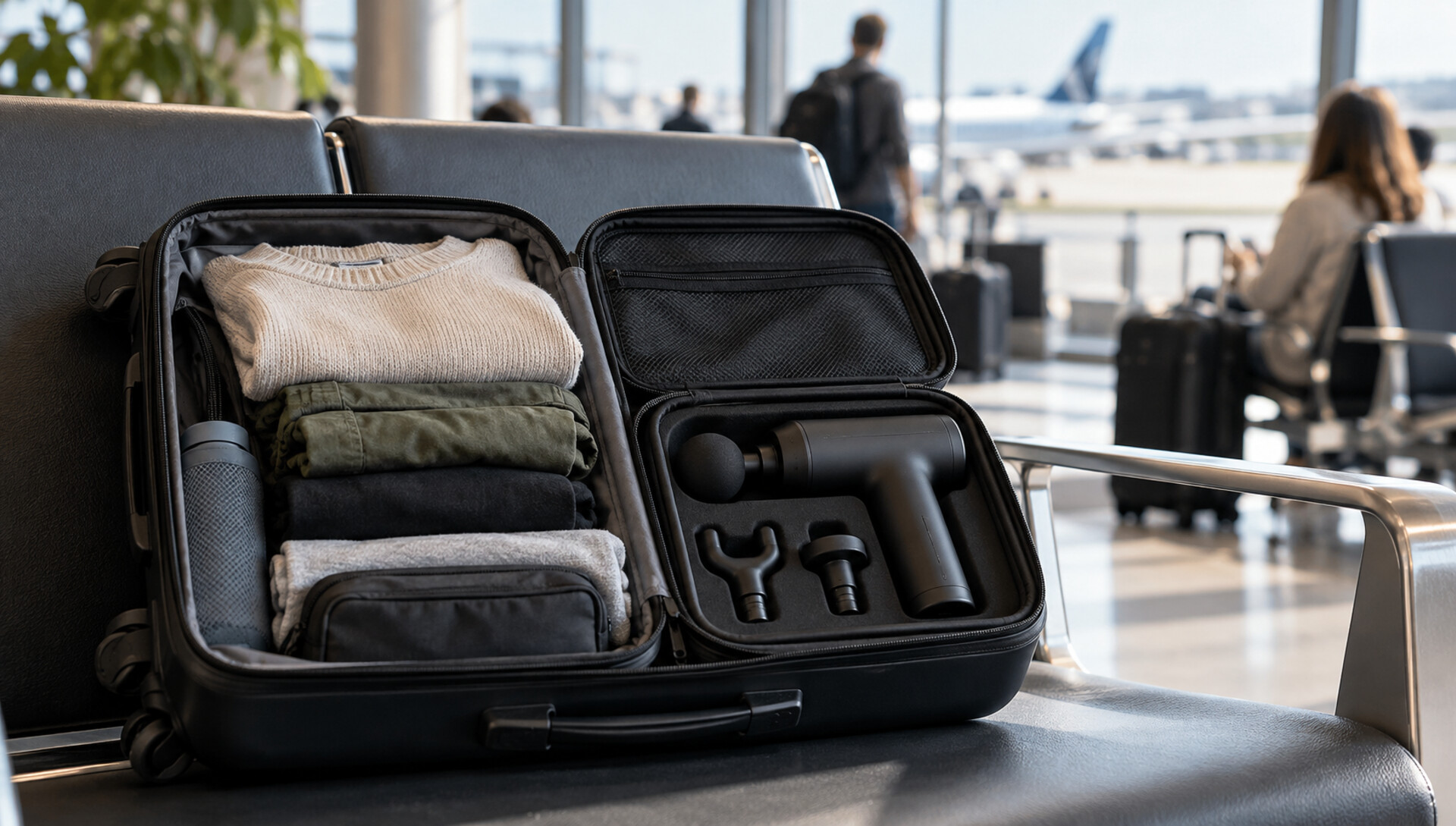
Featured image: AI-generated editorial illustration.
You can usually take a battery-powered massage gun on a flight from Australia when its battery and packing meet the requirements for your device, airline and route. Cabin baggage is the sensible starting point for a typical eligible portable device, but check its watt-hour rating and the operating airline’s rules before packing.
Australian dangerous-goods guidance distinguishes a battery installed in equipment from a spare battery. Manufacturer instructions can be more restrictive than general category advice, so an overseas TSA article or a retailer’s “travel friendly” label should not be your only source.
Policy check: 2 November 2026. Requirements can change. Confirm the current rules with the operating airline before travel.
How is a massage gun assessed for flying?
A rechargeable percussion massager is generally assessed as electronic equipment containing a battery. Its name does not make it a firearm, but airport staff still determine how an item is screened and whether it meets their requirements.
Have the model, official battery specification and a clear label photograph available. These are more useful than saying the gun is only small. If the label is unreadable, get the complete pack’s rating from the maker before departure.
Our massage-gun buyer’s guide covers the wider device format. For flying, use the battery installed in your exact model rather than figures for another device in the range.
Should it go in carry-on or checked baggage?
CASA recommends cabin carriage for eligible portable electronic devices. Its general guidance allows some installed-battery devices in checked baggage when fully switched off and protected against damage and accidental activation. That does not mean every massage gun can be checked.
Philips’ support advice for its PPM7302, for example, says it may travel on a plane but should not be consigned. Follow the stricter applicable instruction when your particular device, airline or airport imposes additional conditions.
| Situation | What to check | Packing priority |
|---|---|---|
| Installed lithium-ion battery up to 100 Wh | Airline and manufacturer conditions | CASA recommends cabin carriage; checking can have extra conditions |
| Over 100 Wh and up to 160 Wh | Operating-airline approval | Arrange approval before travel |
| Over 160 Wh | Passenger-baggage restrictions and freight options | Do not treat it as an ordinary cabin device |
| Spare lithium battery | Rating, quantity and approval limits | Cabin baggage, protected terminals |
| Damaged or recalled battery | Manufacturer and airline advice | Do not pack it as normal working equipment |
Our mini massage-gun guide compares portable formats. “Travel” describes convenience; it is not an airline approval.
How do you find the watt-hour rating?
Look for Wh on the battery, device or official specification sheet. Use the rating for the complete pack. A mains charger’s output or input voltage is not automatically the battery’s nominal voltage.
Watt-hours = battery voltage × amp-hours.
For an illustrative calculation, a 12 V, 2 Ah pack is 24 Wh. If capacity is given in milliamp-hours, divide by 1,000 to express amp-hours first. This is arithmetic, not a specification for a particular massage gun. Do not add or multiply individual cell figures without knowing how the pack is configured.
If you are unsure, ask the manufacturer for the complete pack’s Wh rating in writing. Keep it with your travel documents. A missing specification is easier to resolve before you reach the airport.
How should you pack it?
Switch the device completely off, secure it in a suitable case and protect the power button from being pressed. Pack attachments so they cannot move against the housing or damage other belongings. Keep the label and any required approval accessible.
If staff need to check your cabin bag at the gate, tell them it contains battery-powered equipment and spares. Follow instructions about what must be removed. Do not leave spare lithium batteries in a bag going to the hold.
You may choose a non-powered tool for a particular trip. Our massage gun versus foam roller comparison can help you weigh practical differences. It does not alter baggage rules for either item.
What changes on an international itinerary?
Check each operating carrier, not only the airline that sold the ticket. A connection may involve a different carrier, airport security authority and local requirements. Keep written approval where the airline asks for it.
Also distinguish carriage from use. Being allowed to bring a device does not guarantee permission to operate or charge it onboard. Follow cabin-crew instructions and consider other passengers before using a noisy vibrating device.
What should you compare before buying for travel?
Look beyond the gun’s dimensions. Compare the complete case, charger, attachments and packed weight. Clear battery documentation and a reliable way to prevent activation are practical details worth checking before purchase.
Our Australian massage-gun comparison covers product options. Match any choice to the current policy for your route rather than assuming every model in a buying guide is approved for every flight.
A final pre-departure check takes little time: confirm the operating airline, save the battery rating, pack spares correctly, protect the device and keep any approval available. Repeat the check for a return flight or changed connection if the requirements differ.
Frequently asked questions
Can I put the gun in checked baggage?
Some installed-battery devices can be checked under specific conditions, but model and airline restrictions may be tighter. Check both before packing.
Can spare batteries go in a checked suitcase?
Spare lithium batteries belong in cabin baggage with terminals protected. Rating, quantity and approval limits still apply.
Is a mini gun automatically suitable for flying?
No. Find its actual battery rating and check the operating airline's requirements. Size and travel marketing do not replace those checks.
What if the rating is missing?
Ask the manufacturer for the complete battery pack's Wh rating, then ask the airline what documentation it accepts. Do not estimate from another model or the charger.
Can I use it during the flight?
Carriage approval does not guarantee onboard use. Follow crew instructions and the airline's electronic-device rules, including charging restrictions.
References
- Civil Aviation Safety Authority. (n.d.). Portable electronic devices containing lithium metal or lithium ion cells, battery or batteries. Retrieved November 2, 2026, from https://www.casa.gov.au/packright/dangerous-good/portable-electronic-devices-containing-lithium-metal-or-lithium-ion-cells-battery-or-batteries-watches-calculators-cameras-mobile-phones-laptops-camcorders-etc
- Philips. (n.d.). Can I bring my PPM7302 massage gun on a plane? Retrieved November 2, 2026, from https://www.philips.com.au/c-f/XC000021329/can-i-bring-my-ppm7302-massage-gun-on-a-plane
- Qantas. (n.d.). Battery powered devices and equipment. Retrieved November 2, 2026, from https://www.qantas.com/en-nc/baggage/dangerous-goods/battery-powered-devices-and-equipment