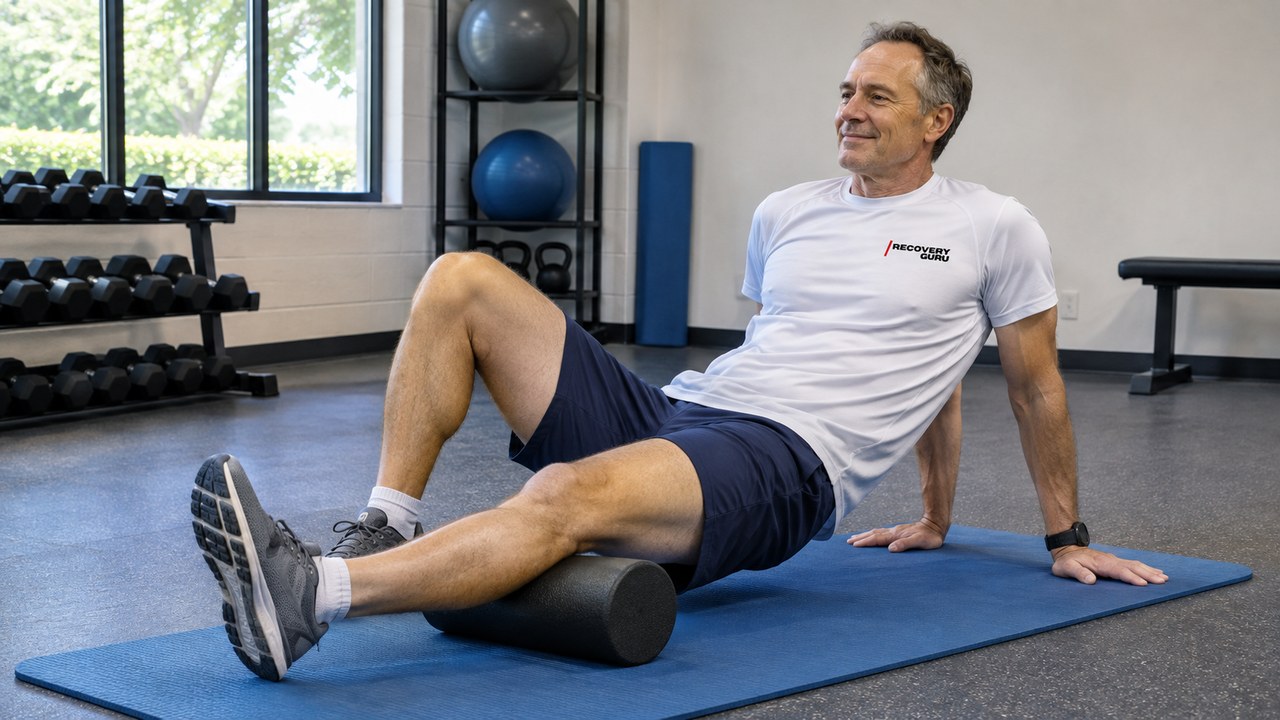
Foam rolling can fit before or after exercise, but the purpose changes. Before a workout, it may be an optional part of getting comfortable with movement. Afterwards, you might use it for a tolerable self-massage session. It does not need to become a long or painful task at either time.
The useful question is what the rolling adds to your routine. If you finish a session more tender because you pressed harder than you could comfortably tolerate, the timing was probably not the main issue.
Quick takeaways
- Before exercise, keep rolling separate from the movement-based warm-up you need.
- After exercise, assess comfort rather than assuming soreness must be pressed out.
- Research findings vary by outcome, device and protocol.
- Use pressure you can control, and avoid treating an injury with aggressive rolling.
What might foam rolling do before exercise?
A 2019 meta-analysis examined 21 studies of rolling before or after exercise. Pre-exercise effects were generally small, including changes in flexibility, while some performance effects were negligible. That is useful context for an optional warm-up tool, rather than a promise of a better workout (Wiewelhove et al., 2019).
If you choose to roll, give it a clear purpose. You might assess how a suitable muscle area feels before moving into the exercise you have planned. Follow it with controlled movement and the usual progression into your activity.
For a gym session, that could mean easy general movement, a brief comfortable rolling step, then your normal practice sets. The sequence should leave time for the movements you will actually perform.
What changes after a workout?
After exercise, you have a different decision to make: whether rolling feels comfortable and useful at that moment. A floor-based session may appeal to one person and feel awkward to another.
The same meta-analysis found some reductions in perceived muscle pain after exercise, alongside small or negligible changes in several performance measures. An improvement in one measure should not be expanded into a claim that rolling fully restores the body (Wiewelhove et al., 2019).
If soreness is your main concern, our DOMS relief guide covers the broader question. Keep the nature and severity of the discomfort in view rather than choosing a harder roller automatically.
| When you roll | A useful purpose | Keep in the routine |
|---|---|---|
| Before exercise | Optional comfortable movement preparation | General warm-up and activity-specific practice |
| After exercise | A tolerable self-massage session | Food, fluids, rest and sensible next-day planning |
| On a non-training day | Check whether gentle rolling feels useful | Ordinary movement and enough recovery time |
| When pain feels unusual | Pause and assess the symptoms | Appropriate professional advice |
How much pressure should you use?
Choose pressure you can control while maintaining a comfortable position. A roller is useful only if you can get onto it, guide the movement and get off it safely.
You can reduce the load on an area by supporting more weight through your hands, the other foot or another stable contact point. If controlling the pressure is difficult, a different format may be easier to manage.
Our foam-roller comparison discusses different types. Surface texture, density, length and shape change the experience. The firmest or most heavily textured option is not automatically the most appropriate.
Avoid using pain as a target. If pressure causes sharp pain, tingling, numbness or a worsening response, stop. You do not need to endure an unpleasant session to make the time worthwhile.
Is there a perfect duration?
There is no single rolling duration that fits every muscle, person and training goal. Study protocols are specific to what the researchers measured; they do not all describe the same routine.
Set a practical limit so the activity remains a small part of your preparation or recovery. Follow the equipment guidance and any programme from a qualified professional. Reassess how you move afterwards, rather than simply trying to accumulate more minutes.
A 2022 study examined an intense warm-up in combination with a single foam-rolling bout. It is another example of how the surrounding exercise changes the question being tested. Its findings should not be turned into a universal sequence for every workout (Konrad et al., 2022).
Should you use a roller or another self-massage tool?
Handling often decides this more usefully than a long list of technical claims. A long roller needs floor space and a position you can manage. A handheld stick or smaller tool may be easier to pack or use in a different position.
Our comparison of massage guns and foam rollers explains the differences in format. Choose around the area, your reach and how much control you have over the contact.
If travel is the main issue, our compact foam-rolling and self-massage tools offer another starting point. Portability is helpful when the tool remains comfortable and practical to use.
When should rolling wait?
Seek advice before working over a recent injury, surgery, unexplained swelling or an area with reduced sensation. Be particularly careful about pressure over bruised skin, a rash or an open wound.
Keep direct pressure off joints and the spine, and follow suitable guidance for the body area. If you have a condition affecting circulation or bleeding, ask a clinician whether rolling is appropriate for you.
The aim is a routine you can control. If the area feels worse or the symptoms do not resemble ordinary post-exercise soreness, investigate that rather than changing the time of day you roll.
Frequently asked questions
Is foam rolling better before or after exercise?
The purpose differs, and research does not establish one timing as best for every outcome. You can use an appropriate, comfortable session at the point where it serves a clear purpose.
Can foam rolling replace stretching or a warm-up?
Keep the movement preparation your activity requires. Rolling is an optional tool and does not show by itself that you are ready for the planned exercise.
Should foam rolling hurt?
You should be able to control the pressure and position. Stop for sharp pain, tingling, numbness or worsening discomfort rather than treating those sensations as a goal.
Do I need to roll every muscle?
No. A routine can be short and selective. Use suitable guidance for the areas you choose and leave out positions you cannot manage comfortably.
Is a firmer roller always better?
No. Density and texture change how the device feels. Choose one that lets you manage the load and move comfortably.
References
Konrad, A., Bernsteiner, D., Reiner, M. M., Nakamura, M., & Tilp, M. (2022). An intense warm-up does not potentiate performance before or after a single bout of foam rolling. Journal of Sports Science and Medicine, 21(2), 145–152. https://doi.org/10.52082/jssm.2022.145
Wiewelhove, T., Döweling, A., Schneider, C., Hottenrott, L., Meyer, T., Kellmann, M., Pfeiffer, M., & Ferrauti, A. (2019). A meta-analysis of the effects of foam rolling on performance and recovery. Frontiers in Physiology, 10, 376. https://doi.org/10.3389/fphys.2019.00376