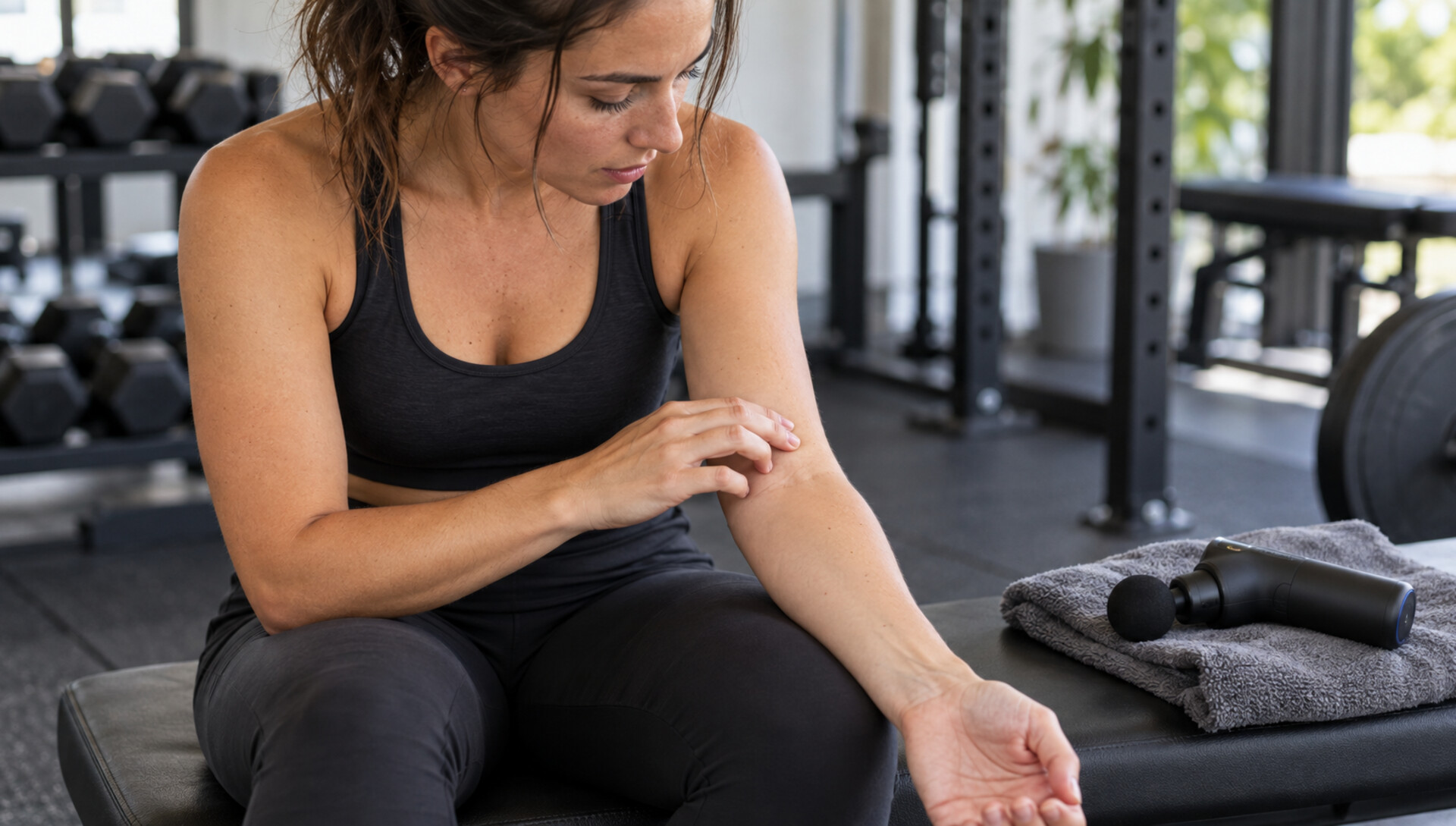
Featured image: AI-generated editorial illustration.
If a massage gun makes your skin itch, pause the session and check the area. Itching is not a reliable sign that the device is working better. Pressure, rubbing, something touching your skin or a reaction to vibration may be relevant, but the sensation alone cannot identify the cause.
A short-lived itch without visible changes is different from raised hives, swelling, pain or bruising. Do not repeatedly treat the same spot to see whether it settles. Recurrent symptoms, an obvious rash or uncertainty about what you are seeing are reasons to ask a health professional before using the gun again.
This is general information, not a diagnosis or a personal treatment plan. In Australia, call 000 for a medical emergency and follow any prescribed anaphylaxis action plan.
Why might a massage gun make your skin itch?
Several explanations may need consideration. The attachment moves against your skin, the area may already be irritated, or a product on the skin or device may be relevant. The useful first step is recording what happened rather than deciding immediately that it was histamine, toxins or improved circulation.
Think about the whole setup. Was the attachment clean and undamaged? Had you applied a new lotion? Were you pressing hard through a seam in your clothing? Did the itch stay at the contact area, and was anything visible? Those details can help a clinician assess a recurring problem.
For ordinary setup questions, our massage-gun buyer’s guide explains the device format and practical use. A buying guide cannot determine why your skin reacts, and changing to a stronger model is not an appropriate response to itching.
Can vibration cause hives?
Yes. Vibration can trigger hives in people with vibratory urticaria, an uncommon inducible urticaria. Boyden and colleagues studied an inherited form associated with a variant in ADGRE2. The findings explain a particular vibration-sensitive condition; they do not show that most massage-gun itching has that cause (Boyden et al., 2016).
DermNet describes localised itching, redness and swelling following vibration in affected people. Raised wheals or repeated reactions deserve assessment. Do not use your massage gun to perform a home provocation test or start medication simply to make device use possible.
What should you do when itching starts?
Switch the gun off and leave the area alone. Look in good light and note any redness, raised skin, swelling or bruising. A photograph and a note of the timing may be useful if the reaction recurs or you seek advice.
| Observation | Useful detail | Practical response |
|---|---|---|
| Itch without an obvious skin change | Location, timing and whether it recurs | Pause rather than repeatedly treating the spot |
| Raised, red or swollen skin | A clear photo and when it appeared | Stop use and seek professional advice |
| Pain, tenderness or bruising | Pressure, duration and attachment | Do not massage over it; arrange assessment if significant or persistent |
| A new lotion or cleaner | Product name and ingredients | Keep the information for the assessment |
| Breathing trouble or throat swelling | Do not delay to collect details | Call 000 in Australia |
When comparing equipment for normal use, look at control, fit and comfortable handling rather than maximum force. Our massage-gun comparison helps with those product differences. It does not make a particular device suitable for someone with a skin reaction.
Is itching proof that circulation is improving?
No. An itch is a symptom, not a circulation test or a measure of recovery. It should not be used to decide that a longer or more forceful session will be beneficial.
The same applies to discomfort after a workout. It is tempting to keep working on an area because you want it to feel better quickly. Our guide to delayed-onset muscle soreness discusses the wider routine. Repeated percussion over reacting skin should not replace ordinary recovery planning.
When does the reaction need medical attention?
Seek advice for recurring itching, hives, swelling, persistent skin changes or uncertainty about the cause. If symptoms include breathing difficulty, throat or tongue swelling, persistent dizziness or collapse, treat them as an emergency. Call 000 in Australia and follow any prescribed anaphylaxis action plan (ASCIA, n.d.).
Severe muscle pain, marked swelling, weakness or dark urine after forceful massage also needs prompt medical assessment. Chen and colleagues reported rhabdomyolysis after exercise followed by percussion massage. One case cannot establish how often an event occurs, but serious symptoms should not be dismissed as an expected recovery response (Chen et al., 2021).
A smaller device does not identify the cause either. If portability matters later, our mini massage-gun guide compares travel formats. Resolve the skin problem first rather than changing devices to reproduce it.
What is worth checking before future use?
If a clinician has assessed the problem, follow their advice about whether to use the gun again. Read the maker’s contraindications and cleaning instructions, inspect the attachment, and avoid adding products the manual does not permit. Massage oil is not automatically compatible with every attachment or housing.
Keep a short record: body area, attachment, approximate duration, intensity, skin products and symptoms. This is more useful than repeatedly trying stronger settings. If the problem returns, stop and update the clinician.
Frequently asked questions
Is it normal for a massage gun to make me itchy?
It can happen, but that does not explain an individual reaction. Pause and seek advice if it recurs or comes with a rash, hives, swelling or pain.
Should I lower the setting and keep going?
Stop first rather than continuing over a reacting area. A lower setting does not establish the cause of the symptoms.
Can oil stop the itching?
Do not add oil as a workaround. The cause is unknown, skin products may be relevant, and some devices are not designed for oils. Check clinical advice and the manual.
Does itching mean fat or toxins are being released?
No useful conclusion about fat loss or detox can be drawn from itching during massage. Check the skin rather than treating the sensation as a goal.
Can a doctor assess vibration-related hives?
A clinician can assess your history and decide whether specialist testing is appropriate. Do not perform your own vibration-provocation test.
References
- Australasian Society of Clinical Immunology and Allergy. (n.d.). Signs and symptoms of allergic reactions. Retrieved November 2, 2026, from https://allergy.org.au/hp/anaphylaxis/signs-and-symptoms-of-allergic-reactions
- Boyden, S. E., Desai, A., Cruse, G., Young, M. L., Bolan, H. C., Scott, L. M., Eisch, A. R., Long, R. D., Lee, C.-C. R., Satorius, C. L., Pakstis, A. J., Olivera, A., Mullikin, J. C., Chouery, E., Mégarbané, A., Medlej-Hashim, M., Kidd, K. K., Kastner, D. L., Metcalfe, D. D., & Komarow, H. D. (2016). Vibratory urticaria associated with a missense variant in ADGRE2. The New England Journal of Medicine, 374(7), 656–663. https://doi.org/10.1056/NEJMoa1500611
- Chen, J., Zhang, F., Chen, H., & Pan, H. (2021). Rhabdomyolysis after the use of percussion massage gun: A case report. Physical Therapy, 101(1), pzaa199. https://doi.org/10.1093/ptj/pzaa199
- DermNet. (2020). Vibratory urticaria. https://dermnetnz.org/topics/vibratory-urticaria