Our buyer's guides are based on years of collective experience from our health enthusiasts, fitness experts, and real-world input from our community. They reflect informed perspectives—not sponsored endorsements.
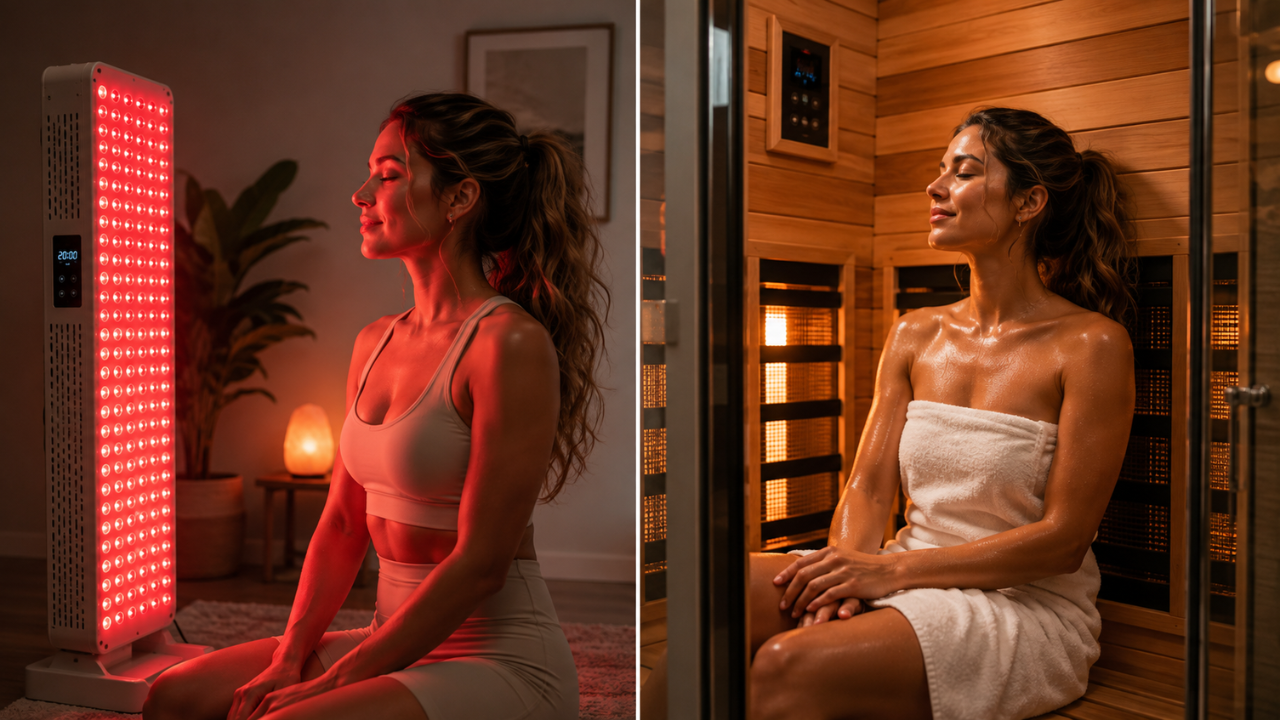
Red light therapy uses specific red and near-infrared wavelengths to deliver light to a target area without aiming to raise core temperature. An infrared sauna uses radiant heat to warm the body and produce a whole-body heat response.
They share the word “infrared”, but they are not the same treatment. A panel is a light-dosing device. A sauna is a heat exposure. Choose between them based on the response you want, not on the assumption that one is a stronger version of the other.
Is Red Light Therapy the Same as an Infrared Sauna?
No. Red light therapy, also called photobiomodulation, commonly uses visible red and near-infrared light. The intended effect is driven by light interacting with biological tissue at a controlled dose.
Infrared saunas use longer infrared wavelengths and heating elements to transfer radiant heat. Air temperature may be lower than in a traditional Finnish sauna, but users still become hot, sweat and experience cardiovascular and thermoregulatory changes.
Our guide to the best infrared saunas in Australia covers the different sauna formats. They should be compared as heat systems, not as oversized red light panels.
What Does Red Light Therapy Do?
Red light therapy exposes a specific area to light at selected wavelengths, irradiance and treatment times. It is studied for applications including skin, muscle recovery, pain and wound-related care.
The treatment area depends on the device. A mask targets the face, a small panel targets one body region and a larger panel can cover much of the body. You generally remain at a fixed distance for a short session.
Photobiomodulation is intended to work without damaging heat. A panel may feel warm, but sweating and a major rise in core temperature are not the goal. The benefits of red light therapy therefore need to be assessed by application and protocol.
What Does an Infrared Sauna Do?
An infrared sauna heats the body. Heart rate and skin blood flow rise as the body works to release heat, and sweating helps regulate temperature.
Research on sauna bathing includes traditional dry saunas as well as infrared formats, and the evidence should not always be treated as interchangeable. Observational studies linking frequent sauna use with health outcomes do not prove that an infrared cabin will create the same result for every user.
The immediate experience is still clear: a sauna produces whole-body heat, while a red light panel delivers a local or broad light exposure with much less thermal stress.
Which Is Better for Muscle Recovery?
Neither is automatically better. They support recovery through different routes.
Red and near-infrared light can be aimed at a sore muscle or joint. This makes a panel convenient when you want a targeted session without heating the whole body.
A sauna creates systemic heat and may feel relaxing after training. Heat can increase skin blood flow and may temporarily change how stiff or sore you feel. It also adds fluid loss and cardiovascular demand, which may be unhelpful when you are already dehydrated.
For a closer look at targeted use, read our guide to red light therapy for muscle pain. Neither method should be used to mask an injury that needs assessment.
Which Is Better for Skin?
Red light therapy is the more direct choice when skin is the main target. Facial masks and panels can deliver specific wavelengths without the prolonged sweating of a sauna session.
Sauna heat may temporarily increase skin blood flow and make the skin feel different, but sweating is not a detox treatment and does not replace cleansing or medical skincare. Heat can also aggravate some conditions, including rosacea, for certain people.
If you have a diagnosed skin condition, choose a protocol with clinical guidance rather than relying on general wellness claims.
Which Makes You Sweat More?
An infrared sauna makes you sweat much more. That is one of its core effects.
A red light panel may create mild warmth, especially at close range, but heavy sweating is not required for photobiomodulation. If a panel makes the skin uncomfortably hot, increase the distance or stop rather than assuming the heat improves the dose.
Sweat loss also means sauna users need to pay closer attention to hydration. Replace fluids based on the session, climate and individual sweat rate.
How Long Does Each Session Take?
Many home red light sessions last around 5 to 20 minutes per treatment area, depending on device output and the intended dose. Larger panels can cover more area at once.
Infrared sauna sessions are often longer because time is needed to warm the body and sustain the heat response. The safe duration depends on cabin temperature, health, acclimatisation and manufacturer guidance.
Do not extend either treatment simply because it feels manageable. Light dose and heat dose both increase with time.
Which Takes Up More Space?
An infrared sauna is the larger commitment. Even compact cabins need floor space, ventilation, suitable power and an installation plan. A red light panel can be mounted, placed on a stand or stored between sessions. When comparing the best red light therapy panels, include the stand and treatment distance in the footprint.
Is Red Light Therapy Safer Than an Infrared Sauna?
Both can be used safely by many healthy adults when instructions are followed, but their risks differ.
Red light therapy risks include eye discomfort, skin reactions, inappropriate dosing and interaction with photosensitising medication or light-sensitive conditions. Use eye protection when required and do not stare into high-output LEDs.
Sauna risks relate more to heat stress, dehydration, dizziness and cardiovascular strain. Avoid alcohol, leave if you feel faint or unwell and do not use a sauna when you cannot regulate heat safely.
People who are pregnant or who have cardiovascular, blood pressure, heat-sensitivity or other relevant medical conditions should seek individual advice before sauna use. Medical guidance is also appropriate before using red light therapy for a diagnosed condition.
Can You Use Red Light Therapy and an Infrared Sauna Together?
Yes, but they do not need to be stacked in the same session. Some sauna cabins include red LEDs, although the quality and dose of those LEDs may not match a dedicated panel.
Which One Should You Choose?
Choose red light therapy if you want:
- targeted treatment for skin, muscles or joints
- short sessions with minimal sweating
- a device that takes up less space
- control over wavelength, distance and light dose
Choose an infrared sauna if you want:
- whole-body heat exposure
- sweating and a sauna experience
- relaxation built around longer sessions
- a permanent home heat setup
Conclusion
Red light therapy and infrared saunas are different tools. A panel delivers selected wavelengths to tissue with little intended heat. A sauna raises body temperature and produces a whole-body heat response.
Choose a panel for targeted light exposure and a sauna for systemic heat. If you use both, dose each one separately and avoid turning recovery into a contest for the hottest or brightest session.
References
Hamblin, M. R. (2017). Mechanisms and applications of the anti-inflammatory effects of photobiomodulation. AIMS Biophysics, 4, 337–361. https://doi.org/10.3934/biophy.2017.3.337
Hussain, J., & Cohen, M. (2018). Clinical effects of regular dry sauna bathing: A systematic review. Evidence-Based Complementary and Alternative Medicine, 2018, 1857413. https://doi.org/10.1155/2018/1857413
Laukkanen, T., Khan, H., Zaccardi, F., & Laukkanen, J. A. (2015). Association between sauna bathing and fatal cardiovascular and all-cause mortality events. JAMA Internal Medicine, 175, 542–548. https://doi.org/10.1001/jamainternmed.2014.8187