This article has been medically reviewed by doctors to ensure it provides accurate, reliable, and up-to-date health information. We only use credible sources to support our content.
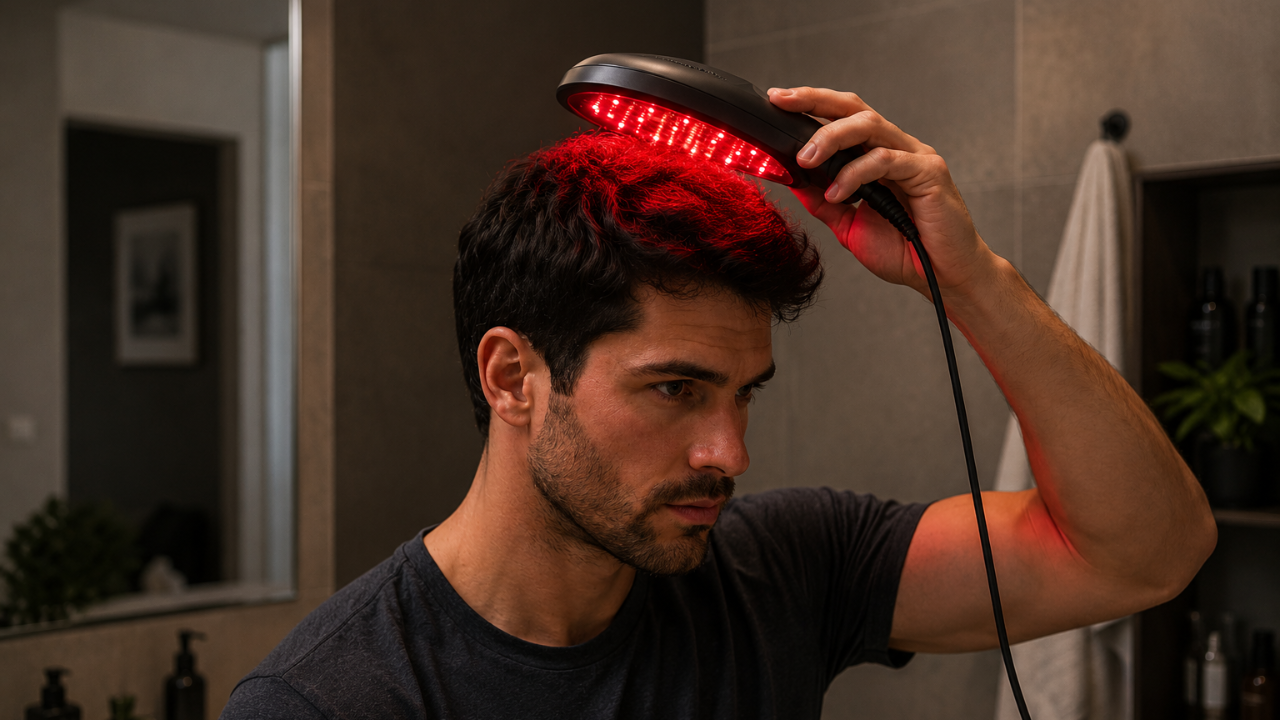
Red light therapy may help some people with male or female pattern hair loss. Randomised trials of specific low-level light devices have reported increases in terminal hair density after consistent use for several months.
That does not mean red light treats every cause of thinning. Sudden shedding, patchy loss, scalp disease, medication effects and nutritional or hormonal problems need the right diagnosis. A light device can be an option within a plan, but it should not delay medical assessment.
Does Red Light Therapy Help Hair Grow?
Evidence is most encouraging for androgenetic alopecia, also called male or female pattern hair loss. This is the gradual, inherited form that commonly causes recession or crown thinning in men and widening of the part in women.
Several sham-controlled studies have found that low-level laser or LED devices can increase hair counts compared with inactive devices. The changes occurred under set protocols, usually after months rather than days.
Results vary, and not everyone responds. Device design, wavelength, dose, treatment schedule, stage of hair loss and consistency can all affect the outcome. The broader benefits of red light therapy should not be used as proof that any red lamp will regrow hair.
How Might Red Light Therapy Affect Hair Follicles?
The exact mechanism is not fully settled. Photobiomodulation is thought to influence cellular energy and signalling, which may affect the hair-growth cycle and activity around the follicle.
Researchers have proposed that light may encourage follicles to move from the resting phase into the active growth phase or help active follicles remain there longer. Anti-inflammatory effects may also be relevant in some settings.
What Type of Hair Loss May Respond?
Most consumer-device evidence relates to pattern hair loss. People with mild to moderate thinning and follicles that are still present may be more suitable candidates than people with long-standing smooth bald areas.
Red light therapy should not be assumed to treat:
- alopecia areata or other autoimmune hair loss
- scarring alopecia
- hair pulling or traction-related loss
- fungal or inflammatory scalp disease
- shedding caused by illness, childbirth, rapid weight change or medication
- hair loss related to iron, thyroid or other medical issues
Some of these conditions may be studied with light therapy in clinical settings, but diagnosis and treatment are different. See a GP or dermatologist if loss is sudden, patchy, painful, itchy, inflamed or accompanied by other symptoms.
Which Wavelengths Are Used for Hair Growth?
Many studied hair devices use visible red light in the mid-600-nanometre range. One helmet-style trial used light centred around 655 nanometres, while other comb and cap designs use their own combinations.
Near-infrared wavelengths may appear in some products, but a longer wavelength does not automatically make a device better for the scalp. The study evidence must match the device and protocol as closely as possible.
Wavelength is only one specification. Irradiance, total energy, coverage, diode spacing, treatment time and the amount of hair blocking the light also matter.
Is a Cap, Comb or Panel Better for Hair Growth?
A cap or helmet offers repeatable scalp coverage and a fixed distance. It can be convenient, but fit and diode placement determine which areas receive light.
A general red light panel can treat the scalp, but hair may block some light and the distance is less fixed. Panels are more versatile for other body areas, while a dedicated hair device is easier to match with published hair-loss protocols. If versatility matters, compare the best red light therapy panels and check whether the manufacturer provides scalp-specific guidance.
How Often Should You Use Red Light Therapy for Hair Growth?
Follow the exact device instructions. Published protocols vary, so a schedule from one cap or comb cannot be transferred directly to another.
Some clinical trials have used treatment three times per week, while other devices prescribe sessions every other day.
More frequent or longer sessions are not guaranteed to work faster. Keep the schedule consistent and track it. Our guide to the best time to use red light therapy can help you attach the treatment to a routine you will remember.
How Long Does It Take to See Results?
Expect months, not weeks. Hair grows slowly, and trials commonly assess changes around four to six months after treatment begins.
If a device helps, continued use may be needed to maintain the effect because pattern hair loss is progressive. Long-term maintenance schedules are not as well established as short-term trial protocols.
Can Red Light Therapy Replace Minoxidil or Finasteride?
Do not stop a prescribed or evidence-based treatment without speaking to the clinician managing your hair loss. Red light therapy may be used as an alternative or an addition for some people, but the best choice depends on diagnosis, medical history, sex, pregnancy plans and tolerance of other treatments.
What Are the Limits of the Evidence?
Many trials are relatively short and test one proprietary device. Some have industry involvement, modest participant numbers or different ways of measuring hair density. There is also no single agreed protocol for wavelength, dose and maintenance.
A statistically significant increase in hair count may not produce a dramatic cosmetic change for every user. Product photographs, unblinded testimonials and claims based on unrelated photobiomodulation studies should be treated cautiously.
The evidence supports a possible benefit for pattern hair loss. It does not support promises of complete regrowth or a permanent cure.
Is Red Light Therapy for Hair Growth Safe?
Low-level light devices are generally well tolerated in published trials, but side effects and practical problems can occur. These may include scalp warmth, dryness, irritation or headache.
Follow the eye-safety instructions even when the light is directed at the scalp. Do not stare at active lasers or LEDs, and use the supplied protection when required. Our guide to eye protection for red light therapy explains why invisible near-infrared output also needs consideration.
Ask a health professional before treatment if you take photosensitising medication, have a light-sensitive condition, have active scalp disease or are being treated for skin cancer on the scalp. Stop if symptoms worsen.
Who Is a Good Candidate?
A reasonable candidate has a confirmed diagnosis of early or moderate pattern hair loss, realistic expectations and a willingness to follow the schedule for several months.
Before buying, spend the money on a proper diagnosis if the cause is uncertain. Matching treatment to the reason for hair loss is more important than choosing between two impressive-looking devices.
Conclusion
Red light therapy can support hair growth for some people with male or female pattern hair loss. The strongest evidence comes from specific low-level light devices used consistently for several months.
It is not a treatment for every form of hair loss and it does not guarantee full regrowth. Confirm the diagnosis, choose a transparent device, follow its protocol and track results under consistent conditions.
References
Avci, P., Gupta, G. K., Clark, J., Wikonkal, N., & Hamblin, M. R. (2014). Low-level laser (light) therapy (LLLT) for treatment of hair loss. Lasers in Surgery and Medicine, 46, 144–151. https://doi.org/10.1002/lsm.22170
Jimenez, J. J., Wikramanayake, T. C., Bergfeld, W., Hordinsky, M., Hickman, J. G., Hamblin, M. R., & Schachner, L. A. (2014). Efficacy and safety of a low-level laser device in the treatment of male and female pattern hair loss: A multicenter, randomized, sham device-controlled, double-blind study. American Journal of Clinical Dermatology, 15, 115–127. https://doi.org/10.1007/s40257-013-0060-6
Lanzafame, R. J., Blanche, R. R., Bodian, A. B., Chiacchierini, R. P., Fernandez-Obregon, A., & Kazmirek, E. R. (2013). The growth of human scalp hair mediated by visible red light laser and LED sources in males. Lasers in Surgery and Medicine, 45, 487–495. https://doi.org/10.1002/lsm.22173