This article has been medically reviewed by doctors to ensure it provides accurate, reliable, and up-to-date health information. We only use credible sources to support our content.
Red light is visible and is commonly used for targets closer to the skin. Near-infrared light is invisible and generally penetrates farther into tissue, making it common in devices aimed at muscles, joints and other deeper targets.
Both are used in photobiomodulation. They sit next to each other on the electromagnetic spectrum and can affect cellular signalling without intentionally heating or damaging tissue. Many home devices combine them because their practical uses overlap.
Is Red Light the Same as Near-Infrared Light?
No. Red and near-infrared light are different wavelength ranges.
Photobiomodulation research often uses red light from roughly 600 to 700 nanometres and near-infrared light from roughly 780 to 1,100 nanometres. Home devices commonly include specific wavelengths such as 630 or 660 nanometres for red light and 810, 830 or 850 nanometres for near-infrared.
Those numbers describe wavelength, not strength. A device also needs enough output, an appropriate treatment time and suitable positioning to deliver the intended dose.
The benefits of red light therapy vary by target and protocol, so the wavelength label is only the start of the comparison.
Can You See Near-Infrared Light?
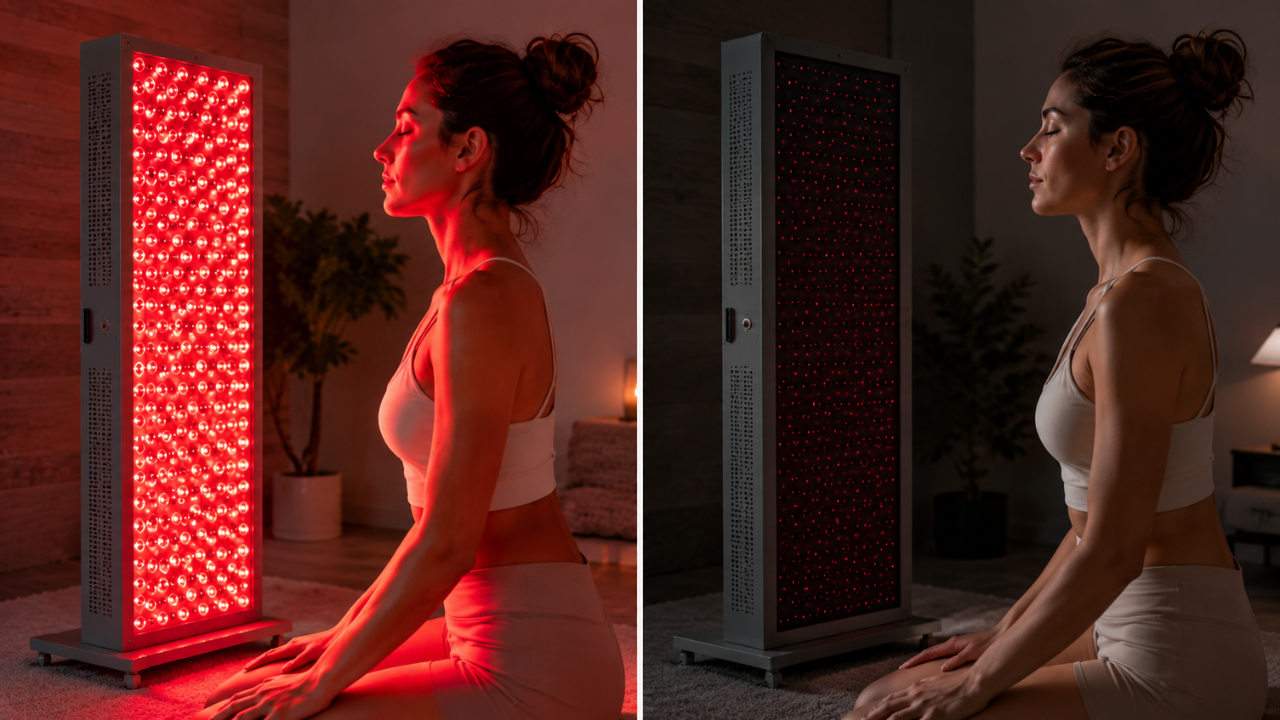
You can see red light, but you cannot see most near-infrared light used in therapy devices. A panel running only its near-infrared LEDs may look off or much dimmer even though it is still emitting energy.
Some near-infrared LEDs show a faint red glow from the edge of their output spectrum. That glow is not a reliable measure of power. Do not stare into the LEDs to check whether they are working.
Use the device controls, indicator lights and manufacturer’s test method. A phone camera may detect some near-infrared wavelengths, but camera sensors and filters differ, so it is not a calibrated measurement tool.
Does Near-Infrared Light Penetrate Deeper Than Red Light?
Generally, yes. Biological tissue absorbs and scatters light, and wavelength affects how far useful light can travel. Red light is commonly selected for superficial targets, while near-infrared light tends to transmit farther before it is attenuated.
There is no universal depth figure that applies to every person or device. Skin thickness, pigmentation, tissue type, blood, wavelength, beam shape and power all influence penetration. The amount of light falls as it travels through tissue, so light reaching a deeper target is weaker than light measured at the surface.
This is why claims that a home panel treats an exact depth should be viewed carefully. Laboratory penetration estimates do not guarantee a clinical effect in a particular joint or organ.
What Is Red Light Commonly Used For?
Red wavelengths are commonly used when the target is at or near the skin. Examples include skincare protocols, superficial wound research and some hair-growth devices.
For skin, the goal is not to tan, peel or heat the tissue. Photobiomodulation uses lower-intensity light to influence cellular processes. Parameters still matter, and findings from one wavelength and dose cannot be transferred directly to every red LED product.
Red light may also reach shallow muscles and other structures. The categories are not absolute. They are a practical way to match wavelength with the likely target.
What Is Near-Infrared Light Commonly Used For?
Near-infrared wavelengths are common in research and devices aimed at deeper tissues. Typical consumer uses include muscle recovery, joint-focused sessions and larger body treatments.
Athletic protocols often combine red and near-infrared light rather than testing one wavelength in isolation. Our guide to red light therapy for sports recovery explains the performance and recovery evidence without assuming every panel produces the same result.
Near-infrared light is also studied in transcranial applications, where light must pass through scalp and skull before reaching brain tissue. This remains a specialised research area. A general home panel should not be treated as a medical device for a neurological or mental health condition. Read the evidence and limitations around red light therapy for brain health before drawing conclusions.
Is Near-Infrared Therapy Better Than Red Light Therapy?
Neither is universally better. The better wavelength is the one suited to the target and supported by an appropriate protocol.
Choose red-dominant treatment when the target is mainly the skin or scalp. Choose near-infrared when the goal involves a deeper muscle or joint. Choose a combined device when you want flexibility or when the intended protocol uses both ranges.
Do not assume that switching on every wavelength is always optimal. A study using 660 nanometres does not automatically support a session using 660 and 850 nanometres at the same total exposure. Combined output changes the dose delivered by each wavelength.
Why Do Many Panels Combine Red and Near-Infrared LEDs?
Combined panels can cover superficial and deeper targets in one session. They are also easier to market as all-purpose devices, so it is important to look beyond the wavelength list.
Check whether the device lets you control the channels separately. Separate controls are useful when you want a red-only facial session, a near-infrared-focused body session or a protocol that specifies both.
When comparing the best red light therapy panels, look for the irradiance of each channel rather than one combined headline number. Also check the treatment distance used for the measurement.
Does Near-Infrared Light Feel Hotter?
Photobiomodulation is intended to be non-thermal, but a powerful panel can still create warmth during use. The warmth may come from the LEDs, electronics, proximity to the device or absorption of the light.
Near-infrared is not the same as a far-infrared heater or infrared sauna. The shared word “infrared” covers a broad part of the spectrum, while the device designs and intended biological effects are different.
Stop or increase the distance if the skin becomes uncomfortably hot. More heat is not evidence that the light is working better.
Can Red and Near-Infrared Light Be Used Together?
Yes. Many research protocols and home panels use both at the same time. This can be practical when treating an area that includes skin and deeper tissue.
Follow the device’s stated distance and session time. Adding a second wavelength channel may increase total irradiance, so do not automatically double the session length. Keep the routine stable long enough to judge tolerance and results.
How Do You Choose the Right Wavelength?
Start with the target, then work backwards:
- identify whether the goal is mainly skin-level or deeper
- find research that matches that goal as closely as possible
- compare the study’s wavelength and dose with the device specifications
- check irradiance at the distance you will actually use
- follow a repeatable schedule rather than changing settings every session
If you are managing a diagnosed condition, ask a qualified clinician whether photobiomodulation is appropriate. Wavelength selection is only one part of treatment planning.
Conclusion
Red light is visible and commonly used for superficial targets. Near-infrared light is invisible and generally reaches farther into tissue.
One is not automatically stronger or better. Match the wavelength, output, distance and time to the goal. A combined device can be useful, but only when you understand what each channel contributes to the total dose.
References
Ash, C., Dubec, M., Donne, K., & Bashford, T. (2017). Effect of wavelength and beam width on penetration in light-tissue interaction using computational methods. Lasers in Medical Science, 32, 1909–1918. https://doi.org/10.1007/s10103-017-2317-4
de Freitas, L. F., & Hamblin, M. R. (2016). Proposed mechanisms of photobiomodulation or low-level light therapy. IEEE Journal of Selected Topics in Quantum Electronics, 22, 7000417. https://doi.org/10.1109/JSTQE.2016.2561201
Zein, R., Selting, W., & Hamblin, M. R. (2018). Review of light parameters and photobiomodulation efficacy: Dive into complexity. Journal of Biomedical Optics, 23, 120901. https://doi.org/10.1117/1.JBO.23.12.120901