
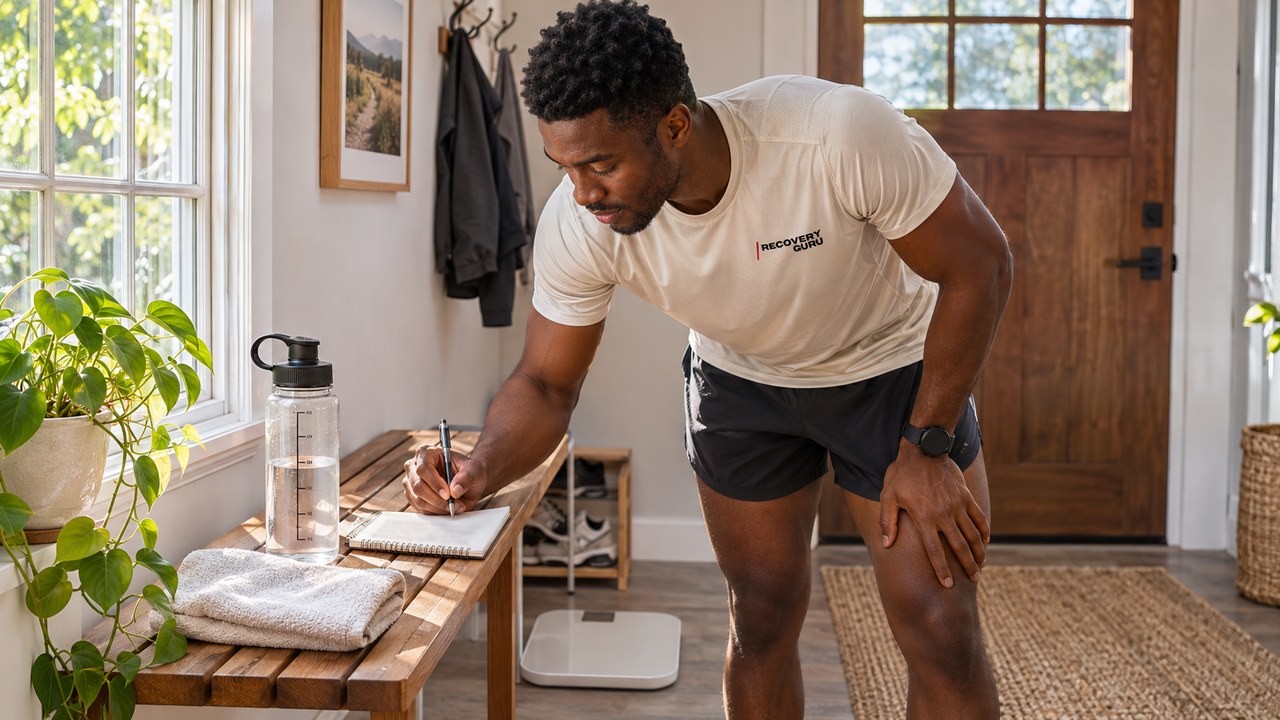
Estimate your sweat rate by comparing body mass before and after a representative exercise session, adding fluid you drank, subtracting urine passed, then dividing by the time in hours. It is a field estimate of fluid loss under those conditions, not a diagnosis or an instruction to replace every millilitre immediately.
You need a reliable scale, a way to measure drinks, a record of time and a normal session you can complete comfortably. Repeating the process in different conditions is more useful than treating one result as your permanent number.
Quick takeaways
- Use the same scale and comparable weighing conditions before and after.
- Account for drinks and urine; body-mass change alone can miss part of the picture.
- Record the weather, clothing, exercise and duration with the result.
- Sweat volume does not tell you sweat sodium concentration or prescribe a drinking target.
What does a sweat-rate estimate tell you?
It gives you a practical estimate of fluid lost per hour during a particular session. The result can help you discuss hydration with a sports dietitian and plan access to drinks.
Baker’s review explains that body-mass changes are useful for estimating whole-body sweat rate, while factors such as trapped sweat in clothing and other sources of mass change can affect the result. Standardising the method matters (Baker, 2017).
An easy session in cool weather and a harder session on a hot day are different tests. Our Zone 2 training guide covers one type of exercise context, but the label alone does not make two sessions comparable.
How should you prepare?
Choose a representative workout rather than exercising harder or longer to create a bigger result. Keep your normal access to drinks and avoid deliberately restricting fluids.
Use the same scale on a stable surface. Weigh in a private, practical setup with dry skin and minimal dry clothing where possible. If you need to keep clothing on, record that and recognise that wet clothing afterwards can affect the estimate.
Measure the fluid available at the start. A bottle with clear volume markings can help. If you are assessing a tracked bottle, our Hidrate Spark review provides one product example; you still need a dependable measure of how much you actually drank.
What is the calculation?
For this practical estimate, one kilogram of short-term mass change is treated as approximately one litre of water.
Estimated sweat loss in litres = starting mass in kg − finishing mass in kg + drinks consumed in litres − urine passed in litres.
Estimated sweat rate in L/hour = estimated sweat loss ÷ exercise time in hours.
The National Athletic Trainers’ Association recommends assessing sweat rate under realistic conditions to help develop individual fluid plans. Its guidance also emphasises avoiding excessive fluid intake (McDermott et al., 2017).
| Measurement | Illustrative result |
|---|---|
| Starting mass | 70.0 kg |
| Finishing mass | 69.4 kg |
| Fluid consumed | 0.5 L |
| Urine passed during the measured period | 0.1 L |
| Exercise duration | 75 minutes, or 1.25 hours |
In this example, estimated sweat loss is 70.0 − 69.4 + 0.5 − 0.1 = 1.0 L. Dividing by 1.25 hours gives an estimated sweat rate of 0.8 L/hour.
These numbers demonstrate the arithmetic. They are not a target for your body or a drinking prescription.
What should you record during and after the session?
Write down the activity, start and finish time, temperature or general conditions, clothing and how hard the session felt. Measure what you drank rather than relying on the bottle’s starting size.
Account for urine passed during the measured period where practical. Do not deliberately delay going to the toilet for the test. If there was none, record zero; if you could not measure it, note that limitation instead of inventing a value.
Afterwards, towel off before weighing and use the same scale and comparable dry conditions. Try to avoid an unrecorded drink or meal between the exercise period and the finishing measurement.
A simple log can contain: date, activity, conditions, start mass, finish mass, drinks, urine, duration and estimated rate. Keep the assumptions beside the result so you can interpret it later.
Why should you repeat the estimate?
Sweat loss varies within a person as well as between people. Exercise intensity, environment, clothing and heat acclimation can influence the result. One run therefore cannot describe every future workout (Baker, 2017).
Precision Fuel & Hydration’s practical guide also encourages measuring under different relevant conditions. Use repeat sessions to understand a range rather than chasing a single perfect number.
Our explanation of cardiac drift during exercise shows another reason to record the conditions. A heart-rate graph and a sweat-rate estimate answer different questions; neither identifies every cause of how a session felt.
Does sweat rate tell you which electrolyte product to buy?
It measures estimated volume, not the concentration of sodium in your sweat. Two people with a similar volume loss can still have different electrolyte requirements.
Avoid turning litres per hour directly into an arbitrary number of tablets. Consider the product label, your food and fuelling plan, medical circumstances and advice from a sports dietitian where needed.
Our electrolyte supplement comparison explains product formats. Compare prepared concentrations and intended uses, rather than choosing a product simply because one test produced a larger number.
How should you use the result sensibly?
Use it to prepare practical questions: Will drinks be available on the route? Is carrying a bottle realistic? Does the session require a more individual hydration and fuelling plan?
Avoid forcing yourself to drink the calculated sweat loss in full. Discuss demanding events, repeated hydration problems or relevant medical conditions with a suitable professional. If you feel unwell during exercise, stop and respond to the symptoms rather than completing the measurement at all costs.
Frequently asked questions
Can I calculate sweat rate from weight loss alone?
You also need to account for fluid consumed and urine passed during the measured period. Otherwise the estimate may leave out important changes.
Should I weigh in sweaty clothes?
Use comparable dry conditions where practical. Trapped sweat in clothing can distort the finishing measurement, so record unavoidable differences.
Does the result tell me how much sodium I lost?
No. Sweat volume and sweat sodium concentration are different measurements. Volume alone cannot prescribe the amount of an electrolyte product.
Should I drink exactly the result every hour?
No. Treat it as information for an appropriate individual plan, not a requirement to replace every millilitre while exercising.
How often should I repeat the test?
Repeat it when it helps represent relevant conditions, such as different weather or exercise intensity. Keep the method consistent so comparisons are useful.
References
Baker, L. B. (2017). Sweating rate and sweat sodium concentration in athletes: A review of methodology and intra/interindividual variability. Sports Medicine, 47(Suppl. 1), 111–128. https://doi.org/10.1007/s40279-017-0691-5
McDermott, B. P., Anderson, S. A., Armstrong, L. E., Casa, D. J., Cheuvront, S. N., Cooper, L., Kenney, W. L., O’Connor, F. G., & Roberts, W. O. (2017). National Athletic Trainers’ Association position statement: Fluid replacement for the physically active. Journal of Athletic Training, 52(9), 877–895. https://doi.org/10.4085/1062-6050-52.9.02
Precision Fuel & Hydration. (n.d.). How to measure your sweat rate. https://www.precisionhydration.com/performance-advice/hydration/how-to-measure-your-sweat-rate/


