
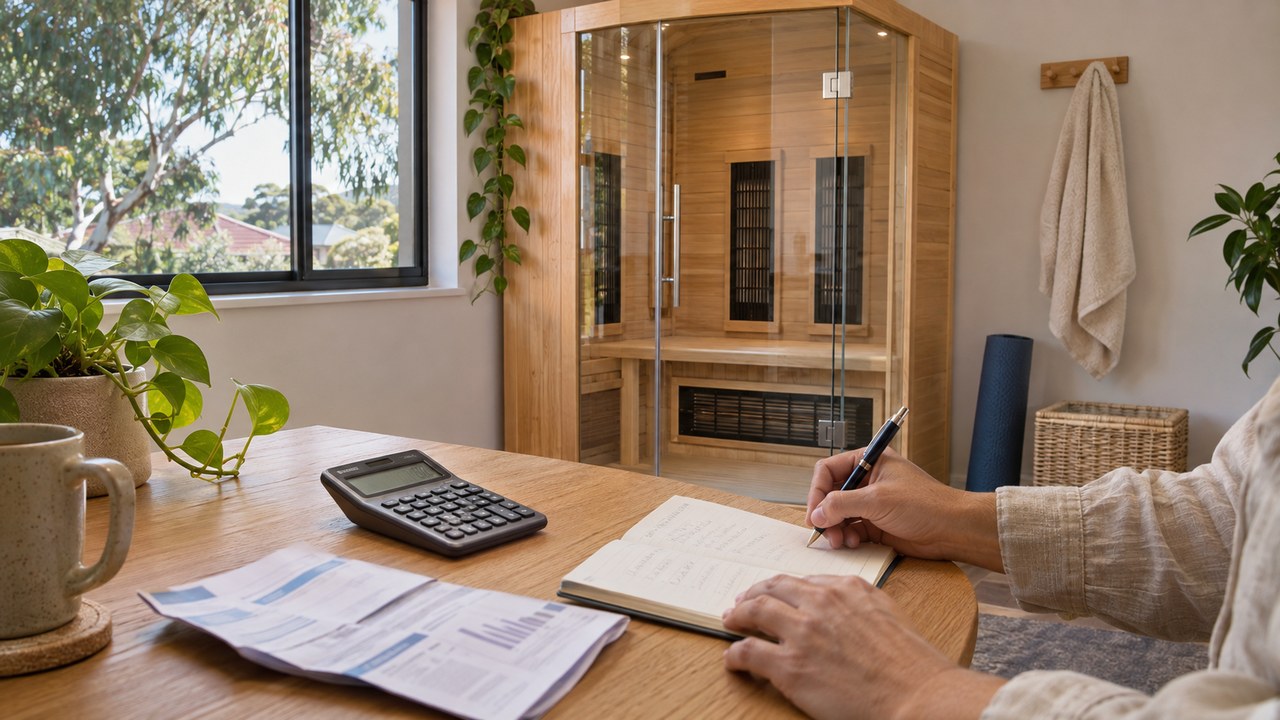
Estimate a sauna’s electricity cost by multiplying its input power in kilowatts by the time it uses that power and your electricity rate per kilowatt-hour. Include warm-up time. For a more accurate result, use measured energy consumption rather than assuming the heater draws full power continuously.
For example, a 2 kW load operating continuously for one hour at an illustrative A$0.35 per kWh costs A$0.70. That is an arithmetic example, not an Australian average or a price promised for a particular sauna.
Quick takeaways
- Find the sauna’s actual electrical input rating and the usage rate on your bill.
- Include the whole powered period, including warm-up and any instructed drying cycle.
- Thermostat cycling can make actual consumption lower than a continuous full-power calculation.
- Compare electricity separately from installation, servicing and the purchase price.
What information do you need?
Start with three items: the electrical input power, the powered time and the applicable electricity tariff. You can usually find input power on the product label or in the manual.
Convert watts to kilowatts by dividing by 1,000. A 2,000 W rating is 2 kW. The kW figure describes power; kWh describes energy used over time. Mixing those units is an easy way to get an estimate wrong.
Check whether a displayed figure refers to the whole sauna, the heater alone or one component. Ask the supplier if the specification is unclear. Lights, controls and other equipment may also use electricity.
Our explanation of how infrared saunas work covers the heating format. For running costs, use the input specification for the actual model, rather than a general statement about infrared equipment.
How does the basic calculation work?
For a continuous load, the calculation is straightforward:
Energy used in kWh = input power in kW × powered time in hours.
Electricity cost in A$ = energy used in kWh × tariff in A$/kWh.
If the tariff is quoted in cents, convert it to dollars before multiplying. A rate of 35 cents is A$0.35, rather than A$35. Also convert minutes to hours: 45 minutes is 0.75 hours.
The South Australian Government’s appliance-cost guidance uses this method and notes that thermostat-controlled equipment may consume less energy than a continuous full-power estimate (Government of South Australia, n.d.).
| Illustrative input | Total powered time | Energy at continuous full power | Cost at A$0.35/kWh |
|---|---|---|---|
| 1.5 kW | 45 minutes | 1.125 kWh | A$0.39 |
| 2 kW | 60 minutes | 2 kWh | A$0.70 |
| 6 kW | 60 minutes | 6 kWh | A$2.10 |
| 9 kW | 60 minutes | 9 kWh | A$3.15 |
These are deliberately labelled examples, not typical consumption figures for named products. Powered time includes warm-up and other operating stages; choose bathing duration according to the manual and suitable personal advice.
Why can the electricity meter show a different result?
A heater may run differently while warming the room and while maintaining temperature. Once a thermostat starts cycling the heater, the energy consumed over an hour can differ from the nameplate power multiplied by one hour.
Room size, installation, insulation, starting temperature and how often the door opens also matter. Compare a complete session under ordinary conditions rather than a brief reading from one stage.
If you want a closer estimate, record energy use over several comparable sessions using a suitable measurement method. For fixed-wired or higher-current equipment, ask a qualified electrician about appropriate metering. Use a plug-in meter only where its rating and the appliance instructions permit it.
Our infrared-sauna buying guide gives you models to compare. Ask sellers whether quoted running costs include warm-up, which tariff they assume and whether consumption was measured or calculated.
How should you compare infrared and traditional saunas?
Compare complete operating periods at the same electricity tariff. A shorter heating period at a higher input power can consume less than a much longer period at a lower input power, or vice versa. Power alone cannot settle the cost of a session.
Write down the assumptions for both products: input rating, warm-up, use time, heater cycling and any drying process specified by the maker. If one quotation includes warm-up and the other omits it, the price comparison is incomplete.
Our guide to traditional, infrared and steam-sauna differences explains the formats. Treat running cost as one part of that decision, alongside space, installation and the experience you want.
What does that mean over a year?
Multiply your realistic per-session figure by the number of sessions you expect to use. An illustrative A$0.70 session used three times a week for 52 weeks gives 156 sessions and A$109.20 in electricity.
Use a frequency that resembles your household’s routine. If several people share one heated period, that differs from reheating the room for separate sessions later in the day.
Keep the estimate easy to update. Save the tariff date, measured or assumed kWh, and session count. If your plan changes, replace the rate instead of rewriting the whole calculation.
What other costs belong in the buying decision?
Keep electricity distinct from delivery, assembly, electrical work, cleaning, servicing and any replacement parts. A low operating estimate cannot tell you whether the installation is affordable or suitable for your property.
For a traditional model, our traditional-sauna comparison is a useful starting point. Confirm the electrical requirements of the exact heater and room configuration with the supplier and electrician.
Solar generation also deserves a careful comparison. Electricity used directly from solar may avoid grid purchases, but it can have an opportunity cost if that power would otherwise earn a feed-in payment or serve another household load. Battery use adds another set of assumptions.
Frequently asked questions
Does a 2 kW sauna use 2 kWh every hour?
It would use 2 kWh if it drew 2 kW continuously for that hour. Thermostat cycling and other operating conditions can change actual energy consumption.
Should I include warm-up time?
Yes. Count the whole powered period, including any instructed drying cycle, when estimating the electricity used for a session.
Which electricity rate should I use?
Use the applicable usage rate from your bill or plan. For time-of-use plans, account for when the sauna operates. Include any demand-charge effect where it applies.
Is infrared always cheaper to run?
Compare complete sessions for the actual products. Input power, duration, cycling and installation conditions all influence the result.
Can I use a basic plug-in meter?
Only when the meter’s rating and the appliance instructions permit it. Fixed-wired or higher-current equipment may need an electrician to advise on suitable measurement.
References
BSC Wellness. (n.d.). Sauna and steam room cost: What drives the price. https://www.saunas.com.au/guides/sauna-steam-room-cost-factors/
Government of South Australia. (n.d.). Calculate appliance running costs. SA.GOV.AU. https://www.sa.gov.au/topics/energy-and-environment/using-saving-energy/calculate-running-costs


