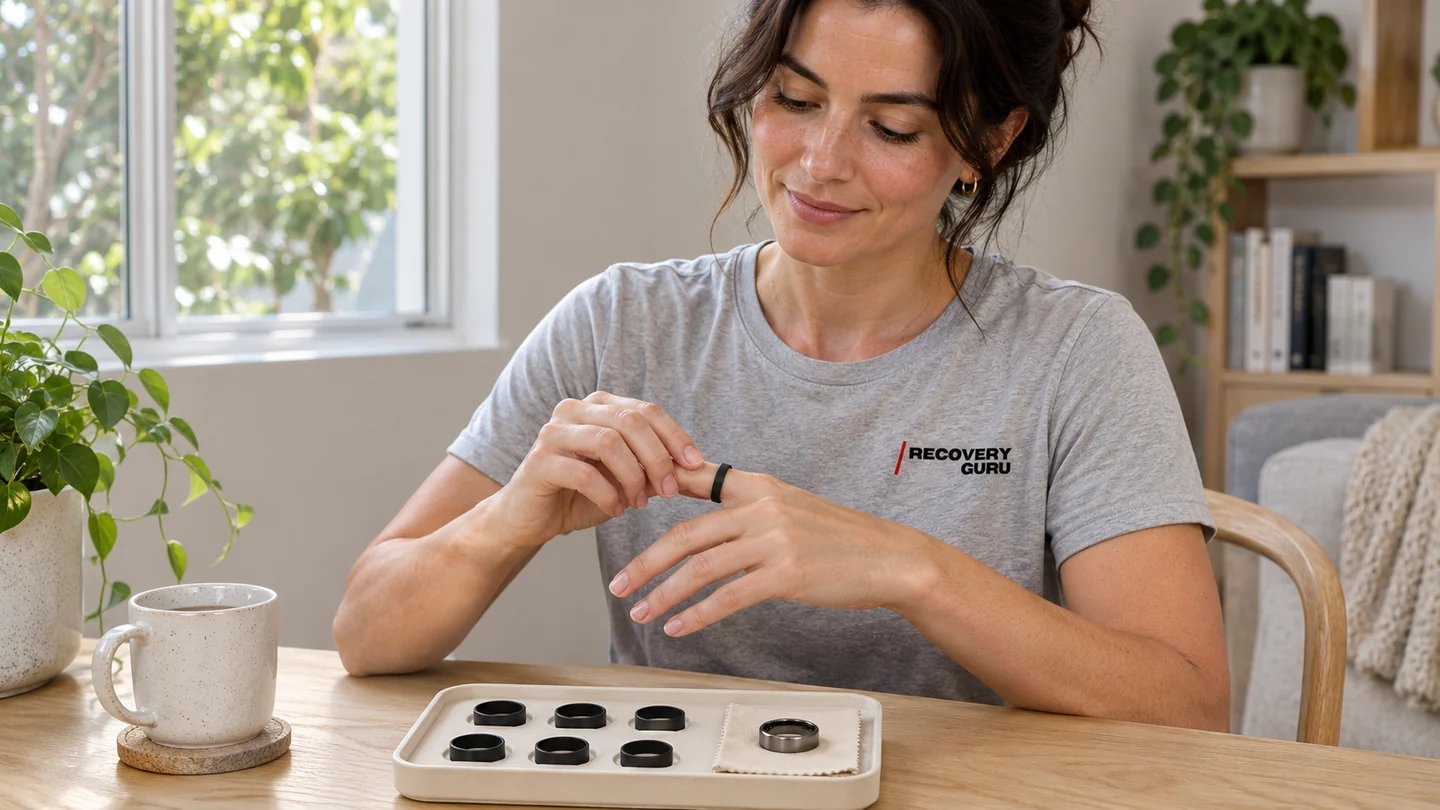
A smart ring should feel snug and secure without pinching, persistent pressure or difficulty removing it. Use the sizing kit for the exact brand and generation, then check the fit during ordinary daily activities and overnight for the period the manufacturer recommends.
A quick try-on at your desk is a useful first step, but it is not the whole decision. The ring needs to work with the finger you will actually wear it on, including changes you notice through the day.
Key takeaways
- Choose the correct model-specific sizing kit; ordinary jewellery sizes do not always transfer.
- Check comfort, stability and removal, rather than chasing the tightest possible fit.
- Follow the manufacturer’s recommended trial period and include overnight wear where advised.
- Confirm exchanges and returns before ordering, especially if buying through a different retailer or overseas.
Why does a smart-ring sizing kit matter?
A smart ring has an inner shape and sensor arrangement that may differ from a conventional jewellery band. The sizing sample is intended to help you assess that particular design, not every smart ring on the market.
Start by checking the kit’s brand and generation against the exact product you want. A familiar size number is not a reason to skip that step. If you are upgrading, confirm whether the older sample still applies instead of assuming it does.
Our smart ring comparison for Australian buyers can help you narrow the models first. Once you have a shortlist, use each model’s own sizing process.
What does a good fit feel like?
Look for a balance between secure contact and comfortable wear. The sample should not feel as though it is about to fall off during ordinary movement, but it should not leave you wanting to remove it because of pressure.
| What you notice | What to check | What not to assume |
|---|---|---|
| The sample rotates or moves easily | Confirm its orientation, the recommended finger and the manufacturer’s fit test | That the next size down is automatically correct |
| It feels secure but comfortable | Trial it through the recommended day-and-night period and assess removal | That a five-minute try-on predicts every situation |
| Pinching, persistent marks or uncomfortable pressure | Remove the sample and reconsider the size or finger | That tighter contact is worth discomfort |
| A different finger seems better | Whether the manufacturer supports that finger and whether its fit remains comfortable | That all fingers need the same size |
The actual ring and a plastic sample can feel different in material and surface finish. Use the sample as directed, then check the delivered ring’s comfort rather than ignoring a problem because the number matches.
Which finger should you use?
Use a finger supported by the manufacturer and practical for your routine. There is no reason to apply one brand’s preferred finger to every device.
Consider the hand you use for work, existing jewellery and activities that may require removal. A ring that is constantly knocked against a tool, another ring or a hard handle may be inconvenient even when the size feels reasonable.
Oura’s guidance includes a specific orientation and fit test, so follow the instructions for your generation. Our Oura Ring 4 review gives the wider model context; it should be read alongside the current sizing instructions.
How long should you try the sample?
Use the trial period stated by the manufacturer. Oura recommends wearing its sizing sample for at least 24 hours, including sleep. Ultrahuman also provides a day-and-night sizing process for Ring AIR. Check the current guide supplied with your kit rather than using a brief try-on as a substitute.
Keep a simple record of the situations you actually want the ring to suit:
- Morning: note how it feels on waking and whether it is straightforward to remove.
- Normal daytime use: assess comfort while typing, walking and doing ordinary tasks.
- Evening: check whether the fit feels different from the morning.
- Overnight: follow the brand’s instructions and assess comfort when you wake.
The point is to observe your own fit, not deliberately create extreme conditions. A sauna, ice bath or heavy lifting session is not a sensible shortcut for stress-testing a plastic sizing sample.
What if you are between sizes?
Do not apply a universal “always size down” rule. Compare the candidate sizes on a supported finger through the full recommended trial, then follow that manufacturer’s between-size advice.
If one option spins freely and the other is uncomfortable, the answer may involve another supported finger or a different model’s shape. A size number alone cannot resolve that trade-off.
Ask the retailer before confirming the order if you remain unsure. Explain which kit and sizes you tried, the finger, when the discomfort occurs and whether the issue is pressure, rotation or removal.
Our Ultrahuman Ring AIR review discusses that model’s everyday format. Its fit should still be assessed with its own kit rather than an Oura sample.
How should you check the ring after delivery?
Before a long wear period, confirm the model and size, inspect the inner surface and follow the brand’s setup instructions. Keep the packaging and read the seller’s exchange terms before deciding that the fit is final.
Check the permitted sensor orientation and allow the app to complete normal setup. If a record is missing, fit is only one item to review alongside battery, settings and synchronisation. Do not keep tightening the fit in an attempt to fix an app problem.
A ring that was comfortable in the morning still deserves attention if it later pinches or becomes difficult to remove. Follow the maker’s removal guidance. Seek medical help promptly if a ring cannot be removed and the finger is painful, numb or discoloured; do not force it or try to cut a powered ring yourself.
Should you keep it on for every activity?
Follow the activity and care restrictions for the actual device. A good everyday fit does not override a manufacturer’s instruction to remove it for a particular task.
For barbell work and other gripping activities, our guide to wearing a smart ring while lifting weights looks at that separate decision. Plan where you will safely store the ring when removal is appropriate.
Clean and dry the ring and finger as directed, including after permitted wet activities. Do not add a sleeve, insert or improvised spacer unless the manufacturer approves it for that model.
Frequently asked questions
Should a smart ring move at all?
Some movement during daily life is different from a ring that feels loose or repeatedly loses its intended position. Use the brand’s orientation and fit test, then check comfort over the recommended trial period.
Can I use my normal ring size?
Use it only as a rough starting point. The exact sizing kit is a better way to assess the smart ring’s shape and recommended fit.
Can I switch the ring between fingers?
Check which fingers and orientation the manufacturer supports, then confirm the fit on each intended finger. A ring that fits one finger may be too loose or tight on another.
Do I need a new kit when upgrading?
Confirm the manufacturer’s guidance for the new generation. Do not assume a previous kit or another brand’s size number is interchangeable.
References
- Oura. (2026, October 7). How to choose the right Oura Ring size. Oura Member Care.
- Oura. (2026, June 19). Product safety & use. Oura Member Care.
- Ultrahuman. (2026, September 24). Find your ideal size using the Ultrahuman Ring sizing kit. Manufacturer guidance.