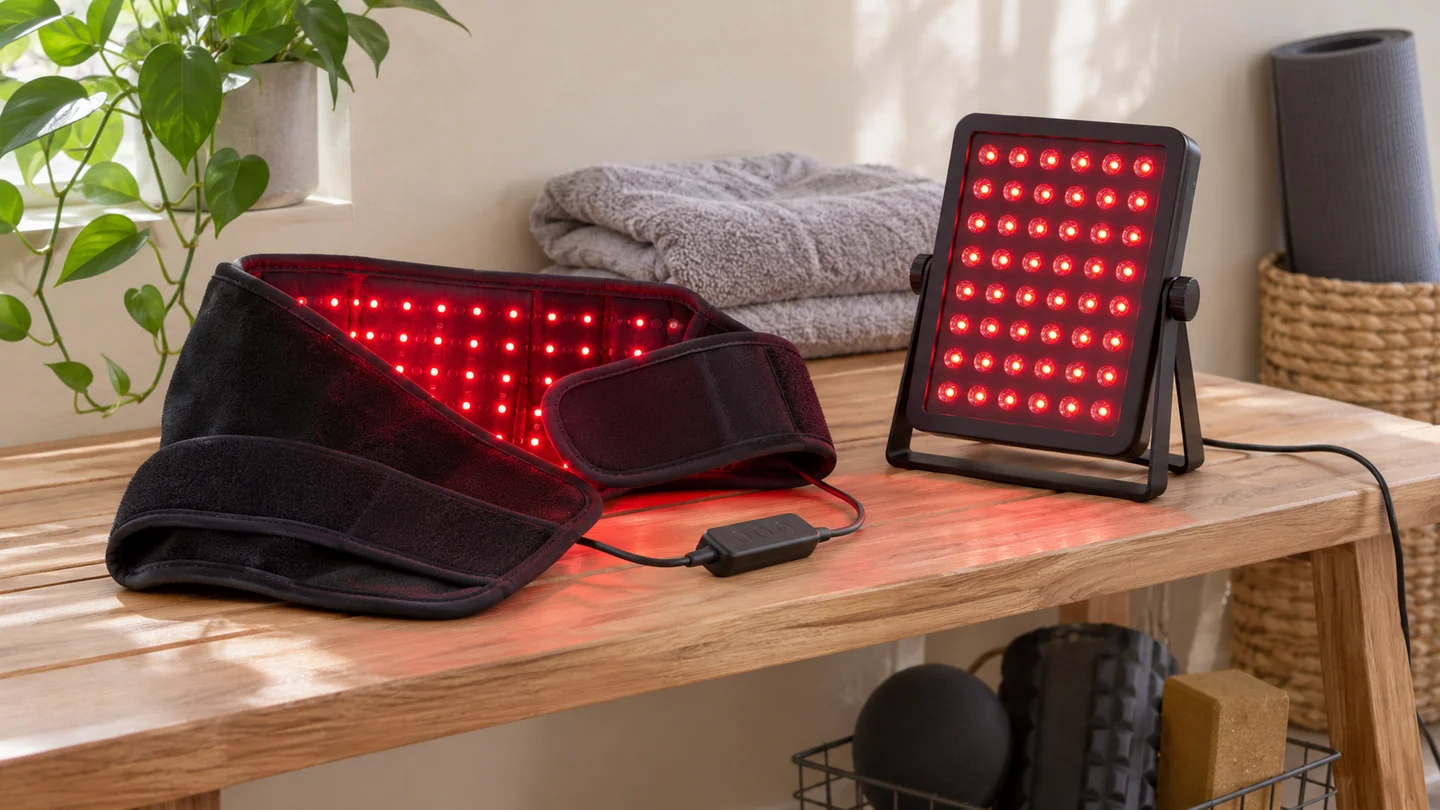
A red light therapy wrap is designed to sit on or close to a particular body area; a panel is positioned at the distance specified by its manufacturer. Choose between them by comparing coverage, positioning, controls and the routine you can realistically follow. A wrap is not automatically stronger because it sits closer, and a larger panel is not automatically better for every purpose.
Start with one practical question: where do you want to use the device? A small area that is easy to secure is a different setup from a broad area you want to expose while sitting or standing.
Key takeaways
- Compare a wrap’s intended close-to-body use with a panel’s measured working distance.
- Check the illuminated area, rather than assuming the product’s outer dimensions are all active treatment space.
- Do not copy a panel’s session settings to a wrap, pad or pod.
- Comfort and convenience matter, but they do not establish an equivalent clinical effect.
What is the practical difference?
A wrap or pad brings flexible equipment to the body. A panel usually stays on a stand, wall mount or other approved support while you position yourself relative to it. The details vary: a flexible pad may need support, a wrap may use straps, and a larger pod may enclose much more of the body.
| What to compare | Wrap or pad | Panel |
|---|---|---|
| Positioning | Usually intended for a defined close-to-body arrangement | Use the stated working distance and mounting position |
| Coverage | May fit a particular area; check the actual lit section and fit | Depends on panel size, distance, beam pattern and your position |
| Hands-free use | Depends on straps, support and whether the manual permits that posture | Depends on a stable approved stand or mount |
| Care | Check skin-contact surfaces, straps, seams and permitted bending | Check the housing, vents, cables, stand and cleaning instructions |
| Moving between areas | May require refitting or moving the pad | May require repositioning yourself or the approved support |
For rigid-device examples, our red light therapy panel guide brings together different sizes and formats. Use it to compare equipment, not to assume every panel delivers the same exposure.
When might a wrap be the more convenient choice?
A wrap can make sense when the intended area suits its shape and the device stays in place comfortably. Check the strap range, closure, cable position and controller access. A product that slips, pinches or pulls on its cable may be awkward to use consistently.
Try to picture the actual session. Will you sit upright, lie down or support the area on a chair? Does the manual permit that position? Can the controller remain accessible without being trapped underneath you?
Some products combine LEDs with other features. Compare each function separately rather than assuming every “three-in-one” device works in the same way. Our Novaa Back Pad review is one place to examine that kind of format and its everyday setup.
A strap does not necessarily make equipment suitable for walking around, exercising or sleeping in. Follow the intended use, cable and charging instructions.
When might a panel be easier to live with?
A panel may suit a routine where you can keep a clear, repeatable position in front of a stable device. You do not have to fasten it around the body, but you do need somewhere appropriate to use it.
Check the mounting arrangement before comparing output figures. A tabletop unit, hanging panel and large wheeled stand have different space and handling requirements. Include clearance for the device’s own ventilation and keep cables out of the walking route.
Make sure the area you want to expose falls within the usable coverage at the stated distance. A larger gap can change coverage as well as the light reaching the surface. Our red light panel distance guide explains why a single maximum-output number is incomplete.
Does contact mean a wrap is more effective?
No comparison of clinical effect follows from contact alone. In their review of photobiomodulation parameters, Zein et al. (2018) describe how wavelength, irradiance, exposure time, delivery method and other conditions interact. Equipment format is only one part of that picture.
A pad touching the body and a panel used at a stated distance can have very different measurement and exposure conditions. Matching a headline wavelength or a calculated energy figure does not, by itself, establish the same treatment effect.
That is why a device’s instructions belong with that device. If the aim is to manage a diagnosed condition, ask an appropriate clinician about the intended use and evidence. A comfortable fit or strong-looking specification is not evidence that a consumer product can replace prescribed care.
Which specifications are worth asking for?
Request information that describes the device as you will use it, rather than the largest figure in an advertisement.
- Intended use and body area: what the manufacturer actually designed the product to do.
- Wavelengths: the stated light output, with each mode identified.
- Irradiance and measurement conditions: where and how the figure was measured.
- Usable coverage: the illuminated section of a wrap, or coverage at a panel’s working distance.
- Session instructions: the permitted position, settings, duration and any required eye protection.
- Other functions: heat, vibration or other features should have their own controls and limitations explained.
- Care and support: cleaning, allowed flexing, charging, warranty and access to replacement components.
Input watts describe electrical power use. They are not a complete measure of the light reaching the body, nor a clinical score. LED count and product dimensions also leave important questions unanswered.
What about comfort, cleaning and storage?
These details can decide whether a device fits your routine. For a wrap, check whether the contact surface and straps can be cleaned without wetting connectors, and whether a removable cover changes the intended setup. For a panel, check safe access for wiping its surface and maintaining its support.
Only bend, fold or roll flexible equipment as the maker permits. A flexible exterior is not permission to crease LEDs, wiring or a controller connection. Allow equipment to cool where instructed before storage.
A larger pad can offer a different practical arrangement from a small wrap without becoming equivalent to a rigid full-body panel. Our Novaa Light Pad XL review looks at the size-and-coverage side of that choice.
Which format would we choose?
For a defined area and a comfortable approved fit, start by comparing wraps or pads. For a routine that suits a stable stand and repeatable positioning, compare panels. Then check whether the specific model supplies the information you need.
There is no need to buy the largest format simply because it exists. Choose a device you can position correctly, care for properly and use according to its actual instructions.
Frequently asked questions
Can I use a panel’s treatment time with a wrap?
Do not transfer the settings automatically. Distance, output, contact arrangement and intended use can differ. Use the wrap’s own instructions.
Can I wear clothes underneath a wrap?
Check the exact model’s guidance about skin contact, covers and clothing. An added layer changes the arrangement and should not be assumed equivalent to the specified setup.
Is a red light wrap the same as a heating pad?
No. Light output and active heating are different features. Some devices combine them; others do not. Check the controls and intended functions rather than judging by how warm the product feels.
References
- Hooga. (2026, January 5). How often should you do red light therapy? A practical dosage guide. Manufacturer guidance.
- Zein, R., Selting, W., & Hamblin, M. R. (2018). Review of light parameters and photobiomodulation efficacy: Dive into complexity. Journal of Biomedical Optics, 23(12), 120901. https://doi.org/10.1117/1.JBO.23.12.120901