If your ice bath is not getting cold, start with the selected mode, temperature setting, water flow and chiller airflow. A blocked filter or an obstructed air intake can interrupt normal operation without proving that the refrigeration system has failed. The correct checks depend on the exact chiller.
First separate a slow initial cool-down from a unit that has stopped cooling altogether. A large volume of warm water on a hot day is a different problem from an established setup that suddenly shows an error.
Key takeaways
- Record the model, starting water temperature, target, ambient conditions and any error code.
- Check the settings and observe circulation before assuming the compressor is faulty.
- Follow the model’s instructions for filter changes, clearances, priming and restarting.
- Stop for leaks near electrics, damaged cables or repeated circuit trips. Leave enclosed electrical and refrigeration work to authorised service.
Is the ice bath actually cooling, just more slowly?
Take a starting temperature and check the trend after the operating period recommended by the manufacturer. Avoid switching modes, opening the lid repeatedly or changing the target every few minutes while assessing it.
A displayed target is a request, not a guarantee that the water has already reached that temperature. Check that the display is showing the measured water temperature when you record the result.
Plunge’s Evolve support guidance recommends recording the set point, current water reading, surrounding temperature, visible flow and error code. Its suggested observation period is specific to those chillers; use your own manual to decide how long to wait.
If you are still choosing a setup, our ice bath chiller versus bags of ice comparison explains the practical differences between automated cooling and adding ice manually.
What should you check first?
| Symptom | Owner check | Next step |
|---|---|---|
| Controls are on, but the water is staying warm | Confirm cooling mode, a target below the current water reading and an active operating schedule | Use the model’s stated observation period before changing settings again |
| Weak circulation or a flow warning | Observe the water level, visible flow, external hose routing and filter status | Power down before any permitted filter or strainer work; follow the manual |
| Cooling worsens on hot days | Check the model’s ambient limits, air clearances, sun exposure and lid use | Correct approved installation conditions; contact support if performance remains outside the stated range |
| An error returns after a permitted restart | Photograph the exact code and record what happened before it appeared | Contact support instead of repeating resets or borrowing another brand’s repair procedure |
Are the mode, timer and target correct?
Some systems can both heat and cool. Confirm that you have not selected heating, standby or a scheduled period that is currently inactive. Check the local controls as well as the app.
Make sure the target is within the chiller’s stated operating range. Setting a lower number does not turn a model into a different-capacity chiller. It can also make an ordinary cool-down look like a fault if you expect the new target immediately.
A Wi-Fi problem and a cooling problem are not automatically the same thing. If the manual permits local operation, see whether the physical controls work. Keep the troubleshooting record simple: which control was used, what it displayed and whether the equipment responded.
Is water circulating properly?
The chiller needs the flow its design specifies. Look for a kinked external hose, an unexpectedly low water level or an error that the manual identifies as a flow restriction. Do not reach into an intake or disconnect a hose while the equipment is running.
Filters and strainers deserve attention when maintenance is overdue. Switch the system off according to its instructions before opening a housing, then use the specified replacement, orientation and seals. Running without the required filter is not a sensible shortcut.
Air in a system can also require a model-specific priming or purge procedure. Use the instructions for that exact version. A procedure involving valves on one chiller may be inappropriate for another.
Routine care is easier than troubleshooting an unknown maintenance history. Our ice bath water-change and cleaning guide explains the wider water-care routine.
Can the chiller move heat into the surrounding air?
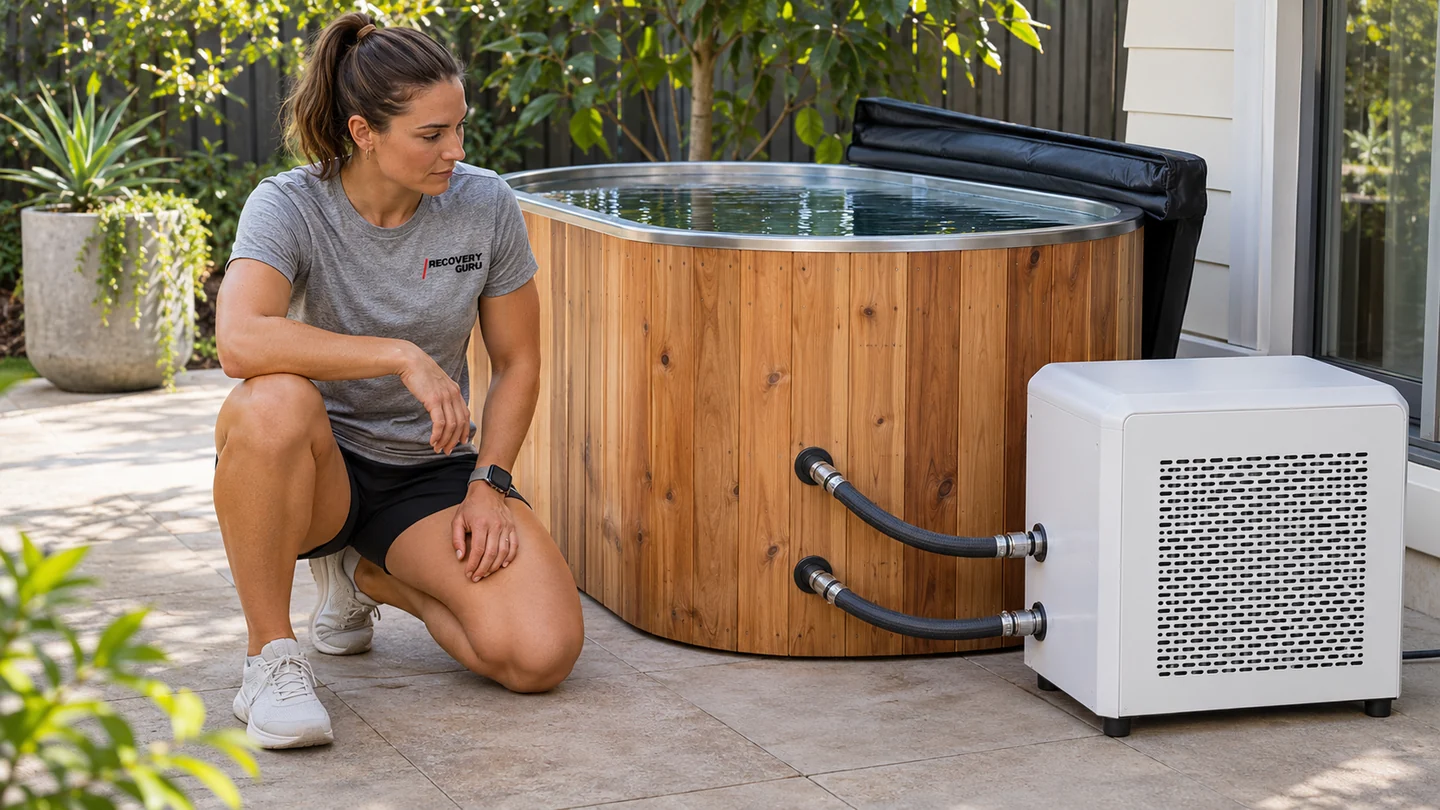
Check the manufacturer’s required intake and exhaust clearances, including the area behind the unit. A chiller squeezed inside an unventilated box can end up drawing back the warm air it has just discharged.
Ritual’s product guidance emphasises airflow and access around its equipment. PlusLife also specifies installation and ventilation conditions in its warranty guidance. Those requirements should be checked against the precise model; one brand’s distance is not a universal rule.
Remove ordinary obstructions only where safe and permitted. Do not dismantle a grille, alter a fan or spray water into the unit. Follow the approved cleaning procedure for external screens or the condenser.
A cover that protects the tub is not necessarily suitable for covering a running chiller. Keep rain protection and ventilation requirements separate.
Has the setup or weather changed?
Consider what changed before the cooling problem appeared: a relocation, a larger fill volume, a new enclosure, direct afternoon sun, a dirty filter or a recent power interruption.
After delivery or relocation, follow any settling and start-up period in the manual. Do not immediately tip, transport and restart a refrigeration unit based on advice for an unrelated product.
If you are assessing a replacement, compare the actual tub-and-chiller configuration, its operating conditions and support requirements. Our Australian ice bath guide helps organise those questions without treating horsepower alone as a complete performance measure.
What should you send to customer support?
Send a short, repeatable account rather than “it feels warm”. Include:
- Brand, model, serial number and purchase details.
- Target and measured water readings, with the time between readings.
- Approximate ambient conditions and the tub’s location.
- Photographs showing the installation and chiller clearances.
- A brief video of visible circulation, plus any error code.
- Filter history, recent moves and checks already completed.
Leave refrigerant, internal wiring, sealed components and recurring electrical faults to authorised service. If there is a burning smell, a damaged cable, water near electrical connections or repeated circuit tripping, stop using the setup. Do not keep resetting it to finish a plunge.
Frequently asked questions
Should the air from a chiller feel cold?
Check the outlet and explanation identified in the manual. A refrigeration system moves heat out of the water, so warm exhaust air can be part of normal cooling. Do not diagnose a fault from an unidentified vent alone.
Can I add ice while the chiller is running?
Ask the manufacturer whether this is permitted and whether it affects water level, intakes or warranty conditions. Adding ice does not identify or fix an underlying circulation or equipment fault.
Does a dirty filter affect cooling?
It can restrict the flow the system needs. Use the specified inspection and replacement procedure, with the equipment switched off as directed.
Should I unplug the chiller and keep restarting it?
Follow its published restart sequence and waiting period. Repeated power cycling can make diagnosis harder. An error that returns needs support rather than increasingly frequent resets.
References
- Plunge. (2026, August 14). Plunge Evolve is not cooling: Standard and Pro chillers. Plunge Support.
- Plunge. (2026, November 17). Water is not cooling (The Plunge Gen 1). Plunge Support.
- PlusLife Health. (n.d.). Warranty information. Manufacturer guidance.
- Ritual Recovery. (n.d.). Frequently asked questions. Manufacturer guidance.