
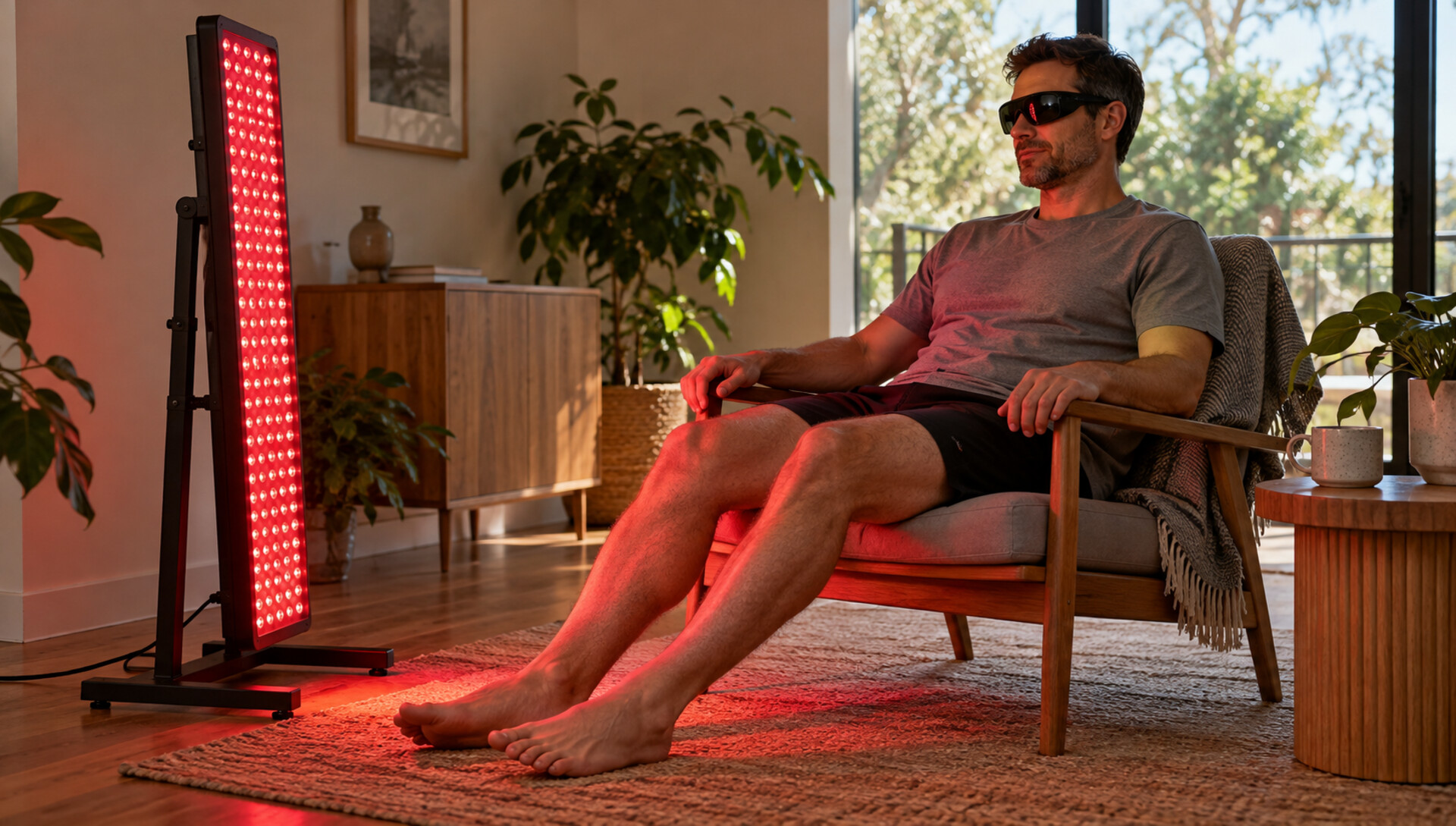
For a home red light therapy session, expose the area you intend to treat if that is what your device instructions require. Keep the rest of your clothing on if you prefer. Do not assume a T-shirt, leggings or a blanket lets the same amount of light reach your skin as an uncovered setup.
Some light can pass through some fabrics. That does not establish how much reaches you, or whether the resulting exposure matches the device’s recommended use. Fabric, wavelength, position and the product itself all matter. The sensible starting point is the manufacturer’s uncovered-skin setup, rather than trying to compensate for clothing with a longer session.
Does red light therapy work through clothes?
There is no reliable yes-or-no answer that covers every device and garment. A white cotton top, a black compression sleeve and a thick towel are different barriers. The term “red light therapy” also covers panels, masks and flexible pads with different instructions.
Infraredi’s support guidance distinguishes red from near-infrared light and recommends removing clothing for its sessions. That is useful product guidance, but it is not a measured transmission chart for everything in your wardrobe. Follow the instructions for the exact device you own, including which area should be exposed.
Distance is a separate part of the setup. Our guide to how far to stand from a red light therapy panel explains why moving closer or further away also changes the exposure. Removing a layer should not be used as a reason to ignore that distance.
What changes when fabric sits between the light and your skin?
A covered area is a different setup from an uncovered one. Colour alone is not enough to judge it: thickness, weave, stretch, multiple layers and the light’s wavelength may all affect transmission. A shirt that looks translucent to your eyes does not tell you exactly how it behaves across a device’s output.
There is also a difference between seeing a red glow through fabric and knowing the dose at the skin. The first is an observation. The second needs appropriate measurement. Without that information, avoid confident claims that a particular material “blocks everything” or “lets all the useful light through”.
| Situation | Practical choice | What to check |
|---|---|---|
| Clothing covers an area outside the intended exposure | Keep it on if comfortable | It should not obstruct the device or the target area |
| A shirt or leggings cover the target area | Expose that area as directed | The manual's skin-contact or positioning instructions |
| A thin fabric appears to transmit a glow | Do not assume an equivalent exposure | Whether the maker provides evidence for covered use |
| A towel or blanket sits in the beam | Keep it outside the intended light path | Ventilation, cable routing and the recommended setup |
| A dressing covers skin under medical care | Ask the treating clinician | Whether light exposure is appropriate at all |
Are red and near-infrared light the same thing?
No. Red light is visible, while near-infrared output is outside the visible range. Devices may offer both, sometimes through separate settings. That distinction does not make a covered session interchangeable with the uncovered use described in the manual.
When comparing products, look for clear wavelength information and usable setup instructions. Our Australian red light therapy panel comparison is a starting point for comparing formats and specifications. A long list of wavelengths is less helpful if the maker never explains how to position the panel.
If a supplier specifically permits use through a garment, ask what material and settings that advice covers. “Near-infrared can pass through fabric” is a much broader statement than “this device has been assessed in this particular covered setup”.
Can you just increase the session time?
Do not invent a time multiplier to compensate for clothing. The amount of light arriving at a surface depends on more than the timer, and the transmission of your garment is usually unknown. Doubling the time does not tell you whether you have matched an intended exposure.
Research on photobiomodulation discusses dose-dependent responses, including situations where increasing exposure does not improve the response. Huang and colleagues’ review is not a clothing study or a universal home-treatment schedule. It does support being cautious about a simple “more is better” rule (Huang et al., 2011).
The same caution applies to protective equipment. Our explanation of eye protection for red light therapy covers a different question from clothing. A T-shirt over the treatment area does not resolve eye-safety requirements.
How can you stay comfortable without covering the treatment area?
Choose a private room and expose only the area the instructions specify. For example, someone positioning a panel towards their lower legs may be able to remain in a T-shirt and shorts. There is no need to turn a targeted session into an uncomfortable full-body setup.
- Read the instructions for clothing, distance, skin preparation and eye protection.
- Arrange a stable seat or standing position before switching the device on.
- Keep fabric away from ventilation openings, controls and the intended light path.
- Use the stated settings and timer rather than improvising around a covered area.
- Stop if the session feels uncomfortable and check the instructions before trying again.
A flexible pad is a different format from a stand-mounted panel. Our Novaa Deep Healing Pad XL review looks at that practical distinction. Use the pad’s own contact and positioning guidance; do not transfer a panel’s distance or time to another device.
Frequently asked questions
Can I wear underwear during red light therapy?
You can keep clothing on outside the intended treatment area if your device instructions allow it. If underwear covers the area you intend to expose, check the manual rather than assuming the fabric makes no difference.
Does thin white cotton let enough light through?
Its appearance is not enough to establish the exposure at your skin. Without device-specific transmission information, use the uncovered setup recommended by the manufacturer.
Can I use a red light panel under a blanket?
Do not put a blanket between the panel and the intended treatment area unless the manufacturer specifically permits that arrangement. Keep blankets away from ventilation openings and electrical components.
Should I remove a bandage for a light session?
Not without advice from the clinician managing the area. A consumer light session should not interrupt wound care or replace instructions about a dressing.
Do I need to undress completely?
Usually the relevant question is whether the intended area needs to be exposed. Follow the device instructions and keep other areas covered for comfort if appropriate.
References
- Huang, Y.-Y., Sharma, S. K., Carroll, J., & Hamblin, M. R. (2011). Biphasic dose response in low level light therapy: An update. Dose-Response, 9(4), 602–618. https://doi.org/10.2203/dose-response.11-009.Hamblin
- Infraredi. (n.d.). Does red & infrared light therapy work through clothes? Retrieved November 2, 2026, from https://infraredi.gorgias.help/en-US/does-red-and-infrared-light-therapy-work-through-clothes-384458


