We include links to products we think are useful for our readers. If you click and buy a product through one of the affiliate links on this page, we may earn a small commission. Please read our disclosure.
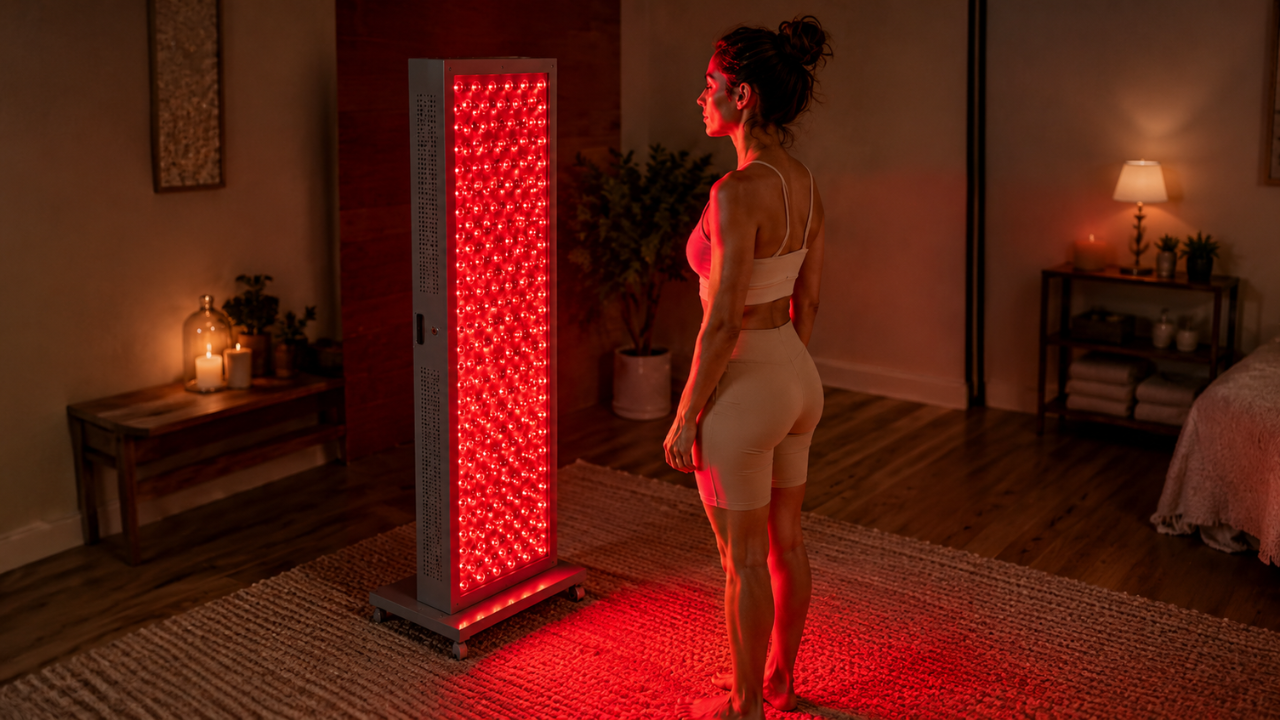
Stand at the distance recommended by your panel’s manufacturer. For many home panels, that is roughly 15 to 45 centimetres, but there is no universal distance that suits every device or treatment goal.
Distance changes how much light reaches each square centimetre of skin and how widely the beam spreads. The correct setup therefore depends on the panel’s measured output, the area you want to cover and the dose you are trying to deliver.
How Far Should You Be From a Red Light Therapy Panel?
Use the manufacturer’s irradiance chart at a stated distance, then follow the matching treatment time. If the instructions recommend 30 centimetres for ten minutes, moving to 10 centimetres while keeping the same time changes the exposure.
As a general setup:
- closer positions provide a smaller, more intense treatment area
- farther positions provide broader coverage with lower irradiance
- large panels usually give more even coverage than small panels at the same distance
- red and near-infrared channels may have different outputs
Treat broad distance ranges online as examples, not prescriptions. A compact low-output panel and a high-powered multi-panel system should not use the same rule.
Independent output testing can reveal differences between advertised and measured figures. Our BlockBlueLight red light therapy panel review shows the type of practical detail worth checking when you compare a device.
Why Does Distance Matter for Red Light Therapy?
Irradiance describes the rate of light energy arriving at a surface, usually stated in milliwatts per square centimetre. When you move away from a panel, irradiance generally falls and the illuminated area becomes larger.
The change is not always a simple inverse-square calculation. Panels contain many LEDs, and at short distances their beams overlap in complex ways. Lens angle, panel size and the position of your body also affect the result.
This is why a measured distance chart is more useful than a single maximum irradiance number. You need to know the output where you will actually sit or stand.
Is It Better to Stand Closer to a Red Light Panel?
No. Closer is not automatically better.
A very close position may create uneven coverage, with bright hotspots directly in front of some LEDs and weaker areas between them. It can also make the session uncomfortably warm and increase the chance of overshooting the intended dose.
Photobiomodulation can follow a biphasic dose response. In simple terms, too little light may not create the desired response, while more light beyond an effective range may add no benefit or produce a weaker response.
Choose enough distance for even coverage and enough irradiance for a practical session time. Do not use skin heat as your dose guide.
How Do You Calculate Red Light Therapy Dose?
If the device provides a credible irradiance figure, you can estimate energy density with this formula:
Dose in joules per square centimetre = irradiance in milliwatts per square centimetre × time in seconds ÷ 1,000
For example, an irradiance of 50 milliwatts per square centimetre for 600 seconds gives an estimated surface dose of 30 joules per square centimetre.
This calculation does not tell you the ideal dose. It only estimates the energy arriving at the surface. Reflection, angle, tissue properties and measurement quality all introduce uncertainty, and the effective range differs between skin, muscle and other targets.
Use the calculation to compare settings on the same device, not to copy a protocol blindly from another panel.
Should the Distance Change for Skin and Muscles?
It may. Facial skincare protocols often use a comfortable distance, moderate output and a consistent schedule. Muscle-focused sessions may use a different wavelength mix, output or surface dose.
That does not mean every muscle session should be closer. Near-infrared light may be selected for a deeper target, but tissue penetration is still limited and a higher surface number does not guarantee that the correct amount reaches the target.
If pain is the reason for treatment, review the evidence and precautions in our guide to red light therapy for muscle pain. Persistent or unexplained pain needs an appropriate diagnosis rather than a stronger light setting.
What If the Manufacturer Does Not Give a Distance?
Missing treatment guidance is a warning sign. A credible device should state the intended distance, time, frequency and wavelength settings.
If you already own a panel with limited instructions, contact the manufacturer for an irradiance chart and protocol. Ask whether the figures were measured with a calibrated meter, whether they include both wavelength channels and whether the result represents an average across the treatment area.
Until you have reliable guidance, use a conservative distance and short session. Do not place the panel against the skin, and do not assume that a longer session will make up for unclear specifications.
How Can You Keep the Distance Consistent?
Mark the treatment position on the floor or use a fixed chair. A measuring tape is more reliable than judging by eye. Keep the panel angle, height and body position similar each time.
For a face or joint, align the target with the centre of the illuminated area. For a large muscle group, move far enough back for even coverage or treat the area in sections if the panel is small.
Consistency also includes timing. Decide whether sessions fit better before or after your usual routine by reading our guide to the best time to use red light therapy, then keep the setup stable.
Do You Need Eye Protection at Different Distances?
Follow the manufacturer’s eye-safety instructions at every distance. Moving back reduces brightness at the eyes, but a high-output panel can still be uncomfortable.
Do not stare directly into the LEDs. Near-infrared light is invisible, so the absence of glare does not mean that channel is off. Use the supplied goggles when required and close or shield the eyes for facial treatment if the protocol allows.
Stop if you develop eye discomfort, headache or persistent after-images. Our guide to eye protection for red light therapy covers the main options.
What Are the Signs You May Be Too Close?
Increase the distance or stop the session if you notice:
- uncomfortable heat or burning skin
- redness that is unexpected or persists
- eye pain, headache or strong after-images
- a patchy treatment area caused by visible hotspots
- symptoms that repeatedly worsen after use
Red light therapy should not burn the skin. If you take photosensitising medication or have a light-sensitive condition, ask a qualified health professional before using a panel.
Conclusion
Use the distance specified for your panel and match it with the stated session time. For many devices that may fall between 15 and 45 centimetres, but the correct position depends on measured output and coverage.
Closer delivers more intensity, not automatically better results. Measure the setup, keep it consistent and use dose information rather than brightness or heat to guide the session.
References
Girasol, C. E., Braz, G. de A., Bachmann, L., Celli, J., & Guirro, R. R. de J. (2022). Laser light sources for photobiomodulation: The role of power and beam characterization in treatment accuracy and reliability. PLOS ONE, 17, e0266193. https://doi.org/10.1371/journal.pone.0266193
Jenkins, P. A., & Carroll, J. D. (2011). How to report low-level laser therapy (LLLT)/photomedicine dose and beam parameters in clinical and laboratory studies. Photomedicine and Laser Surgery, 29, 785–787. https://doi.org/10.1089/pho.2011.9895
Zein, R., Selting, W., & Hamblin, M. R. (2018). Review of light parameters and photobiomodulation efficacy: Dive into complexity. Journal of Biomedical Optics, 23, 120901. https://doi.org/10.1117/1.JBO.23.12.120901