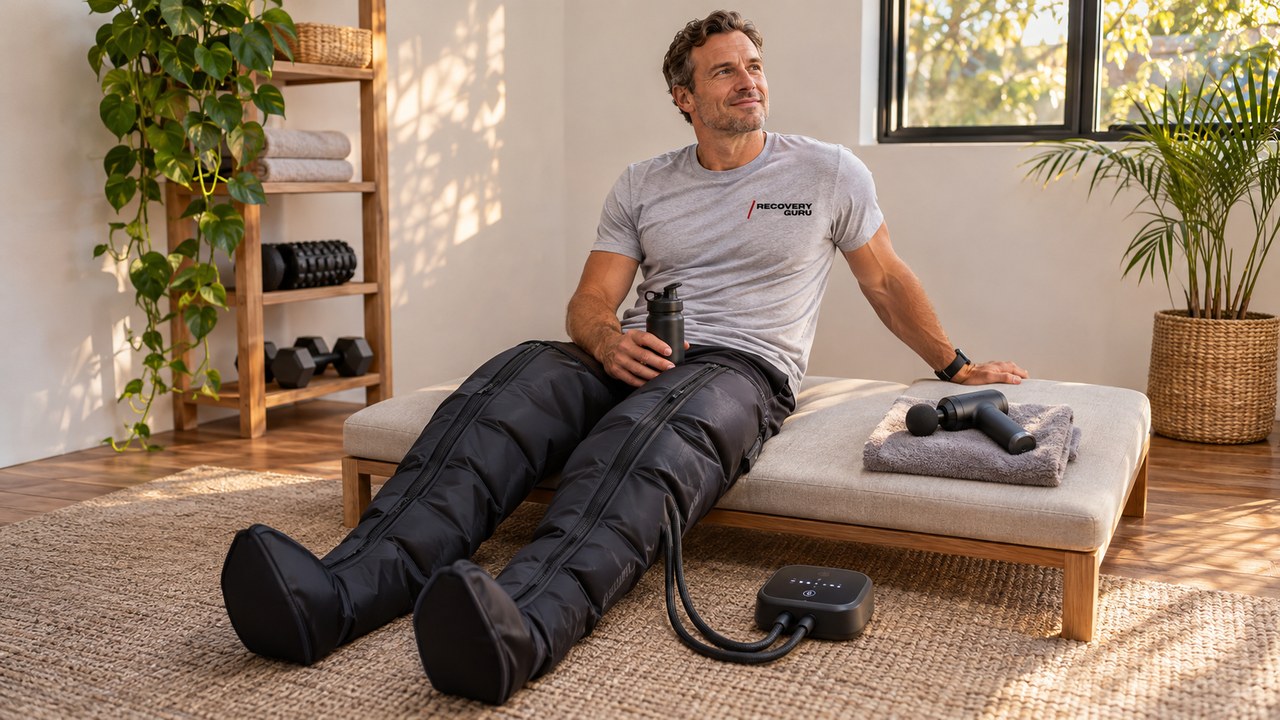
Compression boots are worth considering when you want a seated session covering much of your legs. A massage gun makes more sense when you want to work on a particular accessible muscle. Your budget, available space and willingness to handle the device matter as much as the product category.
Both appear regularly in recovery routines. Neither is an automatic upgrade for every person, and the research does not establish a universal winner. Start with the job you want the equipment to do, then compare the products that actually suit it.
Quick takeaways
- Compression boots inflate chambers around the legs; a massage gun applies percussion through a handheld attachment.
- Boots offer broad coverage with relatively little handling once fitted. A gun lets you choose a smaller area.
- Comfort, easier movement and better performance are different outcomes. A claim about one does not prove the others.
- Check the exact model’s fit, instructions and medical precautions before buying.
What is the practical difference?
Compression boots are sleeves connected to a pump, or sleeves with their own pumps. Their air chambers inflate and deflate in a programmed sequence. You usually sit or recline while the equipment runs.
A massage gun has a moving attachment that you guide over an appropriate muscle area. It requires you to hold the handle, reach the intended spot and control the contact. A powerful motor is less useful if the shape makes that awkward.
Our explanation of how compression boots work covers the mechanism in more detail. The buying question is whether that format suits your normal routine.
| Feature | Compression boots | Massage gun |
|---|---|---|
| Main format | Inflatable sleeves around the legs | Handheld device with a moving head |
| Area covered | Several leg regions within the sleeve | A selected accessible muscle area |
| Handling | Fit the sleeves and operate the controls | Hold and guide the device throughout use |
| Space | Room to sit with the sleeves on | Storage for the device and attachments |
| Fit check | Leg length, circumference and sleeve design | Grip, weight, reach and suitable attachments |
| Travel check | Packed size, pump and battery arrangements | Device size, battery and airline requirements |
When might compression boots suit you better?
Consider boots if your main interest is a comfortable, seated leg session. You may prefer the format after a long training day when holding a device and reaching several areas feels inconvenient.
Before ordering, check how the brand measures its sleeves. Your clothing size is not a reliable substitute for the maker’s leg-length and circumference guidance. Find out whether the foot section fits comfortably and whether you can put the sleeves on without help.
The control unit matters, too. Can you reach it while seated? Are the buttons readable? Where will the hoses go? A wireless design changes the setup, but it still needs suitable storage and charging.
Our compression-boots comparison can help you compare those practical details. Review the current specifications for the exact version being sold.
When might a massage gun be the more useful purchase?
A gun offers flexibility when you want to address an accessible muscle rather than cover both legs at once. You can also move it between suitable body areas, following the manual’s restrictions.
Try to judge handling with your weaker hand as well as your stronger one. Think about the area you actually want to reach. A device that feels manageable for a brief demonstration may be awkward at a different angle.
Attachment choice deserves attention, but the number of heads in a case should not decide the purchase. You need compatible heads you can use comfortably and clean as directed. Some attachments and features are specific to a model or generation.
Our massage-gun buyer’s guide explains amplitude, handling and other specifications. Those details help distinguish two guns that look similar in a product photograph.
Does either tool produce better recovery results?
There is no sound basis for declaring one category best for every recovery outcome. Studies use different devices, populations, timings and measurements, which makes broad comparisons difficult.
A 2024 review of lower-limb pneumatic compression included 17 studies and 319 participants. Benefits varied across muscle function, soreness and muscle-damage measures; its findings do not establish superiority over massage guns (Maia et al., 2024).
The percussive-therapy review by Sams and colleagues also identified limitations in study methods and reporting. It supports careful discussion of possible effects, rather than treating every product claim as settled evidence (Sams et al., 2023).
Decide what you hope to notice. Is it a comfortable session, a temporary change in stiffness, or better performance at your next workout? Keep those questions separate when judging a product or your own experience.
Which is easier to fit into everyday life?
Picture an ordinary weekday rather than an ideal recovery evening. Where will the equipment live? How much preparation will you tolerate? Can you clean and put it away without turning the session into a chore?
Someone with limited floor space may prefer a compact handheld device. Another person may find the seated format of boots easier to use consistently. Someone who struggles with grip or reach should check whether they need help with either setup.
Compare the complete purchase, including the correct sleeves or attachments, delivery, warranty, returns and local support. Prices change, and an overseas headline price may leave out costs that matter to an Australian buyer.
If handling and portability are your priorities, the massage guns in our Australian buying guide provide another useful comparison. Choose features that solve a real problem for you.
What should you check before using either?
Read the exact product’s precautions. Hyperice lists conditions including deep vein thrombosis and acute infections among Normatec contraindications. Therabody also publishes precautions for percussion devices, including recent injury, altered sensation and certain medical conditions. Those lists are reasons to seek appropriate advice, not a checklist for clearing yourself medically.
An unexplained swollen, painful or hot leg deserves assessment before applying compression or percussion. Stop if use causes pain, numbness, unusual skin changes or other concerning symptoms. Increasing pressure or intensity is not a sensible response to discomfort.
Frequently asked questions
Are compression boots a full-leg massage gun?
No. Their sleeves apply changing air pressure around the legs. A massage gun applies percussion through a moving attachment. They create different experiences and require different setup and handling.
Which should a runner buy first?
Start with the task, budget and fit. Broad seated leg sessions may favour boots; accessible targeted use may favour a gun. Running alone does not establish which purchase will be more useful.
Do I need both?
Only if each serves a useful purpose in your routine. Trying suitable equipment before buying can help you decide whether the second device adds enough convenience or comfort to justify it.
Can I use both on the same day?
Follow each device’s instructions and any clinical advice. There is no general requirement to combine them, and a longer sequence should not be assumed to create a better result.
Will either replace sleep and sensible training?
Treat equipment as an optional part of recovery. Keep enough time and attention for food, sleep, hydration and a training load you can manage.
References
Hyperice. (n.d.). Are there any contraindications for the Normatec? https://hyperice.zendesk.com/hc/en-us/articles/360046872273-Are-there-any-contraindications-for-the-Normatec
Maia, F., Nakamura, F. Y., Sarmento, H., Marcelino, R., & Ribeiro, J. (2024). Effects of lower-limb intermittent pneumatic compression on sports recovery: A systematic review and meta-analysis. Biology of Sport, 41(4), 263–275. https://doi.org/10.5114/biolsport.2024.133665
Sams, L., Langdown, B. L., Simons, J., & Vseteckova, J. (2023). The effect of percussive therapy on musculoskeletal performance and experiences of pain: A systematic literature review. International Journal of Sports Physical Therapy, 18(2), 309–327. https://doi.org/10.26603/001c.73795
Therabody. (n.d.). Product warnings and guidance: Precautions and contraindications. https://www.therabody.com/pages/precautions